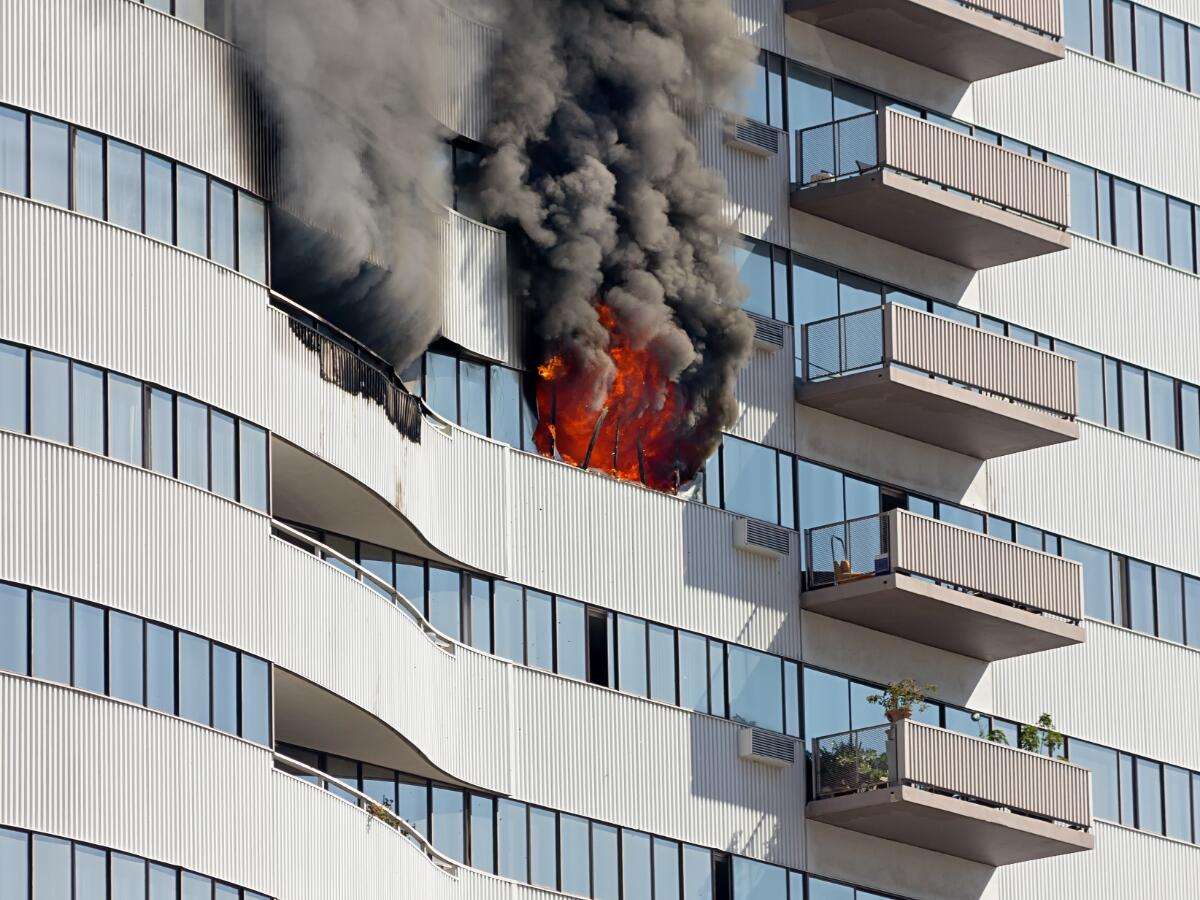
A fire risk assessment from UL Solutions applies safety science to real‑world building conditions, helping you identify risk, protect occupants and make informed decisions about fire safety and compliance.
What is a fire risk assessment?
Definition and purpose
A fire risk assessment is a systematic evaluation of fire hazards, people at risk and fire safety controls within a building. It takes a clear, structured look at how fire could start, who could be affected and what needs to be in place to reduce risk and support safe evacuation.
In the U.K., a fire risk assessment is a legal requirement for most non‑domestic premises and for the common areas of multi‑occupied residential buildings. The duty sits with the “responsible person,” who must carry out the assessment, act on its findings and keep it under review as the building, occupancy or use changes.
As a U.K.-based team, we conduct fire risk assessments grounded in life safety and shaped by the judgment and experience of dedicated fire safety professionals. Our work starts with how all building occupants can evacuate safely in an emergency, then aligns controls, procedures and protections to support that outcome.
At its core, a fire risk assessment program is not just a compliance exercise. It is a practical tool that helps you understand your risks, prioritize the right precautions and protect people, property and continuity — today and over time. At UL Solutions, this evaluation is informed by applied safety science — combining real‑world fire behavior knowledge with building use, systems performance and human factors.
Five steps in a fire risk assessment
Most authoritative fire-safety guidance follows five core steps:
- Identify fire hazards
- Identify people at risk
- Evaluate, remove, reduce and protect
- Record findings, plan and train
- Review and update regularly
Roles and responsibilities
- Responsible person (U.K.) – Typically, the employer, owner, landlord or managing agent, with legal duties to assess risk, maintain precautions, share information and train staff.
- Duty holders (Scotland) – Persons with control of relevant premises must assess risk and implement general fire precautions.
- U.S. employers – Must provide a workplace free from recognized fire hazards and maintain emergency action and fire prevention plans (e.g., 29 CFR 1910.38, 1910.39).
Review frequency
Maintain effective fire risk controls by responding to change. Adjust precautions when people, processes, layouts or conditions shift, and incorporate lessons learned from incidents, near misses and drills so protections remain aligned with how the building is used.
Fire risk assessment steps grounded in real‑world conditions
Identify fire hazards
Look for potential ignition sources such as electrical systems and hot work. Review fuels, including packaging and chemicals, and consider conditions that may increase oxygen availability. Examine storage arrangements and operational processes that could elevate fire risk.
Identify people at risk
Consider employees, contractors, visitors and other occupants who may be exposed to fire hazards. This includes people who are unfamiliar with the building, working alone, present after hours or impaired, as these factors can affect awareness, response and evacuation.
Evaluate and reduce risk
Apply the hierarchy of controls to evaluate fire hazards and find opportunities to eliminate, substitute, isolate, engineer or administratively control risk. Protection measures are also reviewed at this time to determine whether they are appropriate for your building and operations. These may include compartmentation, detection, alarms, suppression, signage and emergency lighting.
Record, plan and train
Document findings, maintain an up‑to‑date emergency plan and deliver role‑appropriate training across the organization, including roles such as fire wardens and hot work permit holders. This supports consistent execution and audit readiness.
Review and update
Reassess at regular intervals and after changes to the building or its use, including fit‑outs, storage changes and staffing patterns, to help maintain effective fire risk controls over time.
Fire risk assessments in North America
Commercial and industrial sites
Assess process hazards such as combustibles, flammables and hot surfaces. Review exit routes and emergency planning requirements based on building use. Compare fire protection measures against applicable Occupational Safety and Health Administration (OSHA) and National Fire Protection Association (NFPA) guidance.
Warehouses and logistics
Evaluate commodity classifications, storage configurations and racking arrangements, while reviewing e‑commerce throughput and how changes in volume or operations may affect fire risk. Assess sprinkler strategy, such as early suppression fast response (ESFR) systems versus in‑rack sprinklers, and consider management of change and inspection, testing and maintenance (ITM) practices to support ongoing system performance.
Healthcare and education
Consider occupant vulnerability and the unique risks associated with healthcare and educational settings. Account for clinical and teaching operations, as well as continuity of care or instruction. Egress strategies and drills should be aligned with how facilities operate day to day and during emergencies.
Fire system effectiveness
Review fire system design intent in relation to current building use. Evaluate impairment controls, device coverage, testing intervals and alarm procedures. Compare system performance against applicable standards to help confirm continued effectiveness.
Business continuity
Translate assessment findings into prioritized remediation actions, readiness drills and resilience recommendations. Focus on reducing disruption, supporting continuity of operations and enabling faster recovery following a fire‑related incident.
Fire risk assessments in the U.K.
Regulatory Reform (Fire Safety) Order 2005
The principal fire safety legislation in England and Wales places a duty on responsible persons to assess and record fire risks and maintain appropriate fire precautions in workplaces and common parts of buildings.
Fire Safety Act 2021
Clarifies the scope of fire risk assessments by confirming that external walls, including cladding and balconies, along with building structure and flat entrance doors, are within scope for multi‑occupied residential buildings.
Fire Safety (England) Regulations 2022
Introduce additional duties, including providing information to residents, completing routine fire door checks, maintaining secure information boxes, preparing plans for fire and rescue services and carrying out checks of lifts and other essential equipment. Requirements vary by building height.
Building Safety Act 2022
Section 156 strengthens the Fire Safety Order (FSO) by expanding recording requirements for fire risk assessments, requiring the identification of competent assessors and improving cooperation and information sharing. These duties came into force on Oct. 1, 2023.
Fire (Scotland) Act 2005
Establishes fire safety duties for duty holders in Scotland and is supported by the Fire Safety (Scotland) Regulations 2006 and Scottish Government guidance.
Fire risk assessments by building type
Offices and mixed-use buildings
Balance tenant fit‑outs, shared services and after‑hours use with clearly defined responsibilities for common parts and effective coordination between occupiers.
Warehouses and manufacturing
Align fire protection with commodity classification and storage and racking strategies, while addressing hot-work controls, battery-charging areas and impairment planning.
Residential and multi‑occupied buildings
Address fire safety risks in common parts, flat entrance doors and external walls across residential buildings, including houses in multiple occupation (HMOs). Consider evacuation strategies and resident communication proportionate to building height and overall risk profile.
Healthcare and care settings
Prioritize progressive horizontal evacuation, compartment integrity, medical gas safety and staff training aligned with clinical risk and patient dependency.
Hotels and hospitality
Focus on sleeping risk, transient occupancy and nighttime staffing, with attention to alarm audibility, clear escape routes and easily understood evacuation guidance.
What a UL Solutions fire risk assessment includes
Overall fire hazards
UL Solutions fire safety experts bring applied safety science to the assessment of ignition sources, fuel loads and process‑specific hazards across your site. Drawing on decades of fire testing, certification and real‑world risk evaluation, our team looks beyond individual hazards to understand how materials, equipment, storage arrangements and daily operations interact to influence fire behavior and potential consequences. This knowledge is shaped by our long history in fire testing, system certification and independent evaluation of how fire protection performs under real conditions.
Occupant and tenant risk
Fire risk is shaped as much by people as by buildings. Our experts evaluate occupant profiles, headcounts, shift patterns and visitor flows to understand how people actually move through and use a space. These insights help inform evacuation strategies, emergency planning and role‑appropriate training that reflect real operating conditions, including after‑hours use, transient occupants and vulnerable populations.
Structural fire risks
UL Solutions assesses compartmentation, service penetrations and external wall features with a focus on how fire, heat and smoke may spread within and between building areas. This evaluation is informed by our extensive experience in fire testing, building system performance and inspection services, helping identify gaps that may undermine the intended fire strategy of the structure.
Means of escape and exits
Our team verifies exit capacity, travel distances, signage, emergency lighting and arrangements for refuge or assisted evacuation. The assessment considers how escape provisions perform under realistic conditions, including reduced visibility, occupant familiarity and varying levels of mobility, helping support safe and timely evacuation in the event of a fire.
Detection, alarms and equipment
UL Solutions evaluates the condition, coverage and suitability of fire detection and alarm systems, sprinklers, standpipes and portable fire‑fighting equipment against applicable standards and recognized good practice. This perspective is strengthened by our long‑standing role in fire system testing, certification and inspection (TIC), which supports confidence that systems are capable of performing as intended when needed most.
Dangerous substances and hot work
Our experts review how flammable materials are stored and handled, including battery storage and charging arrangements that may introduce emerging fire risks. Permit‑to‑work procedures for welding, cutting and other hot-work activities are assessed to understand how controls are implemented in practice, helping organizations manage ignition risk during non‑routine and high‑risk activities.
Using technology and software to manage fire safety compliance
Fire safety software tools
Our experts can recommend and implement software or work with your preferred platforms to centralize fire risk assessment (FRA) findings, asset records and inspection schedules. The right tools support structured document control so reports, evidence and records are consistently maintained and accessible to the right teams. This provides clearer oversight, more consistent follow‑through on actions and stronger audit readiness across sites.
Action and task tracking
Translate findings into prioritized, trackable actions with clear owners, due dates and documented closure evidence to support governance and audit readiness.
Building safety data integration
Align FRA outputs with building safety files and the “golden thread” — a maintained digital record of safety‑critical building information that supports safer design, construction and ongoing occupation — supporting compliance for higher‑risk properties under the U.K.’s new building safety framework.
Why fire risk assessment is essential
Legal compliance
Regular fire risk assessments demonstrate responsible risk management and provide documented evidence of assessment by qualified professionals, supporting compliance with applicable fire safety legislation and regulatory requirements across your jurisdiction.
Life safety
Helps reduce the likelihood and impact of fire by identifying hazards and reviewing prevention measures, early warning systems and evacuation arrangements.
Property protection
Aligns protection measures to hazards and inventory to help limit damage, business interruption and recovery time.
Operational resilience
Strengthens continuity and emergency planning by identifying fire risks and response gaps that can affect operations and recovery.
Why choose UL Solutions for fire risk assessment?
Qualified fire risk assessors
Our assessors are experienced fire safety professionals who apply recognized risk assessment methodologies and reference National Fire Protection Association (NFPA) and Society of Fire Protection Engineers (SFPE) guidance where appropriate.
Cross-sector experience
From logistics and manufacturing to healthcare, education, hospitality and mixed‑use portfolios, we apply safety science across diverse operating environments, tailoring fire risk assessments to your operations, risk profile and business priorities.
North America and U.K. coverage
We operate across the U.S., Canada and the U.K., aligning your fire risk assessment program with applicable local codes, standards and regulatory requirements.
From findings to fire strategy
We translate assessment findings into a practical fire strategy and an implementable improvement plan that internal teams and external partners can act on.
What to expect
Preassessment preparation
We review drawings, occupancy and use details, maintenance and testing records, impairment logs and previous fire risk assessments to focus the site visit on the most relevant risks.
On-site assessment process
Our assessors conduct a structured survey, engage key stakeholders, review supporting evidence and sample life safety systems to evaluate real‑world conditions and performance.
Post assessment next steps
You will receive a prioritized action plan with recommended controls, interim measures where needed, training considerations and a defined review cadence to help maintain compliance over time.
Make fire risk assessment a managed issue, not a surprise
Work with experienced Fire Risk Assessors who deliver thorough, practical assessments and a prioritized plan your teams can act on. Let’s scope your first assessment and book a site visit.
Get connected with our sales team
Thanks for your interest in our products and services. Let's collect some information so we can connect you with the right person.