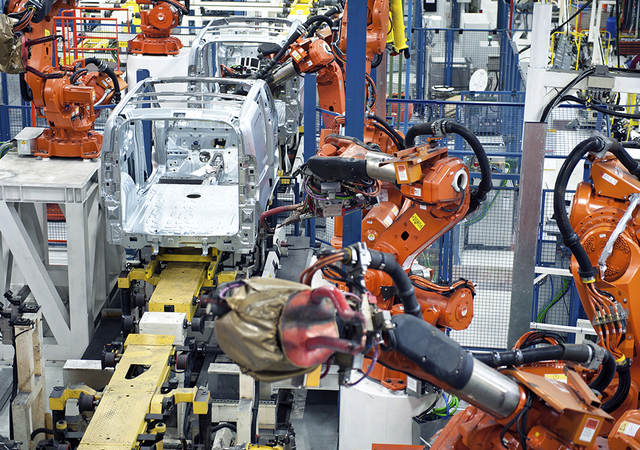
Orange and yellow machines in factory with motor
  • Capability

Factory Commissioning Services

UL Solutions services for factory launches include early code guidance, equipment validation and code authority approval support.

Let's get started Subscribe to our newsletter

UL Solutions factory commissioning services help you streamline launching a new factory

Launching a new factory is a high-stakes endeavor. There are a myriad of risks to mitigate across every stage: initial factory development stages (including planning your facility and construction), regulatory acceptance of equipment and production lines, supply chain sourcing, commissioning of equipment, training of staff, and ongoing maintenance and scalability. Manufacturers must navigate complex local regulations and approval processes for their equipment and systems, as failing to manage these regulatory requirements proactively can significantly delay project timelines and drive up costs.

With decades of global experience, UL Solutions experts help manufacturers align their factory setup with critical safety and performance standards — enabling them to develop operations that are compliant, reliable and ready to launch or scale.

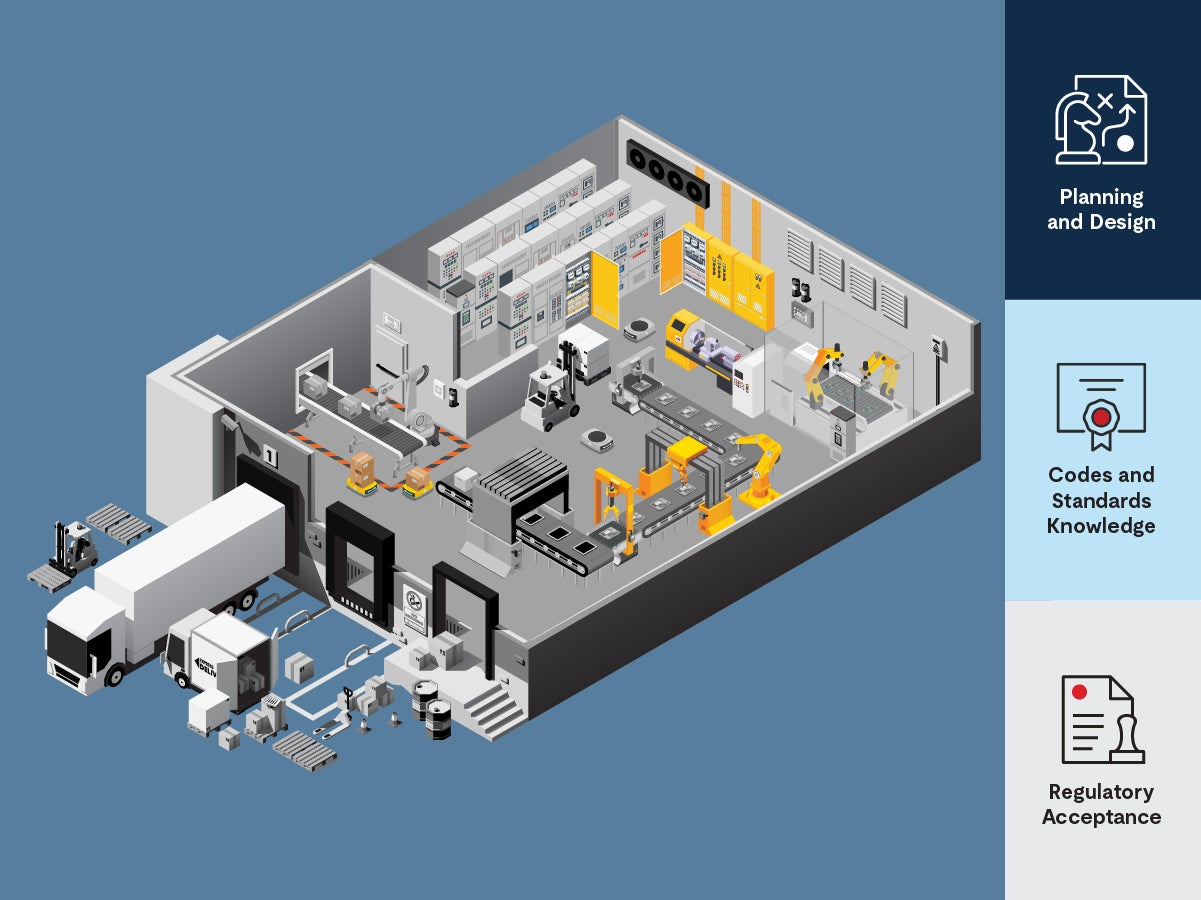
An illustration of a factory floor with key testing areas of focus


Click the QR code to explore codes and standards essential to equipment safety on the factory floor.
Factory Commissioning QR code 2

Will your factory be code-ready for startup?

Before operations begin, a factory must meet all regulatory and safety requirements, from verifying equipment safety to satisfying code authority criteria for code-based installations. For manufacturers in industries such as pharmaceuticals, electric vehicle (EV) batteries,  machinery, electronics and food production, delays in this phase can drive up costs across the supply chain.


The UL Solutions edge

Our global team of experts works directly with code authorities, engineers and operations teams to uncover issues early to help reduce rework and accelerate the transition from facility construction to production.

We deliver documented expertise that evaluates your equipment for safety —  contributing to a safer working environment.


UL Solutions helps companies reduce potential factory startup delays with a comprehensive commissioning support approach that includes:

Wrench inside a gear icon
Pre-commissioning planning:

Conduct early and upfront comprehensive review of applicable standards to understand city, county, state and federal regulations

Icon of an increasing bar graph
Executive and validation:

Third-party validation of supply chain and equipment safety

Icon of an "i" in a circle
Gap analysis and troubleshooting:

Identification of equipment or installation gaps that could hinder code authority approvals

Icon of a person wearing a hard hat inside a shield
Operational confidence:

Demonstration of equipment safety and supporting approvals with code authorities


Benefits of UL Solutions factory commissioning support:


Icon of an "i" in a shield


Early-stage regulatory knowledge support

  • Education on codes, standards and electrical and safety regulations
  • Training on UL Standards
  • Meetings with code authorities


Icon of a hand holding a gear


Validation of supply chain and equipment safety


  • Field evaluation, testing or certification of production line equipment


Icon of a magnifying glass looking at a gear


Demonstration of equipment safety to code authorities

  • UL Field Evaluation Mark and Report
  • UL Certification Mark
  • UL Limited Production Certification Mark


Icon of a magnifying glass observing a factory


Demonstration of safety for equipment modifications or expansions

  • Field evaluations
  • Updated certification

Watch our video

This UL Solutions video highlights the importance of safety, compliance and innovation in today’s rapidly evolving industries, demonstrating how trusted expertise enables organizations to develop safer products and a more sustainable future. Watch the video to get a clear understanding of how UL Solutions is supporting safer living and working environments through science, expertise, and collaboration.

Who benefits?

Beneficiaries of our work include factory owners, engineering, procurement and construction (EPC) entities, facility managers and compliance teams involved in expansion or greenfield builds — especially in regulated sectors. These stakeholders gain:

  • Faster time to operational readiness
  • Enhanced coordination across stakeholders and vendors
  • Reduced risk of equipment safety issues that cause startup delays
  • Greater confidence that systems will perform in accordance with safety requirements

Plan early. Launch strong.

UL Solutions brings clarity, consistency and speed to your factory commissioning phase, empowering your team to launch on schedule and with confidence. Let us help make your next factory build smoother, safer and more successful.

Download our resources
Factory

Factory Commissioning Infosheet

740 KB
UL

UL Solutions Factory Commissioning e-guide

8 MB
UL

UL Solutions Field Evaluation Infosheet

700 KB

Frequently asked questions

How do I determine which local, regional and national codes apply to my new facility — and where do interpretation differences typically cause delays?

Start with a complete regulatory mapping of the destination region, including national standards, state/province codes, and municipal requirements. Because some jurisdictions interpret broader standards differently, early engagement with local Authorities Having Jurisdiction (AHJs) helps avoid misinterpretations that lead to rework. 

If our equipment was previously certified for another country, what additional evaluations or certifications will we need to operate legally in the new location?

Certification rarely transfers automatically across borders. Equipment may require field evaluations, additional electrical safety testing, or new certification marks to meet local standards. A gap assessment identifies where current approvals diverge from destination requirements. 

How can we identify compliance gaps before construction and installation begin, so we avoid redesigns, rework or costly project delays?

Conduct a pre-commissioning compliance review early in the planning stage. This includes comparing facility design, equipment specifications, and control architectures to local regulations. Early discovery is far less costly than retroactive corrections. 

Who needs to be involved internally, and how should we organize compliance responsibilities across teams?

Compliance typically involves engineering, Environment, Health and Safety (EHS), operations, procurement, and IT/cybersecurity. A cross-functional steering group, supported by a compliance advisor, supports understanding among all stakeholders of design implications and sign-off requirements throughout the project lifecycle. 

What are common compliance or permitting mistakes — and how do we avoid them?

The most common mistakes include assuming existing equipment credentials transfer, missing early AHJ coordination, bypassing documentation requirements and underestimating time for evaluations. Proactive planning and third-party advisory support help avoid these pitfalls.

When should we engage Authorities Having Jurisdiction (AHJs)?

As early as possible — ideally in the conceptual design phase. Early alignment reduces approval friction, clarifies expectations and avoids construction or installation work that may later need to be modified or redone. 

How can we meet testing, certification and inspection requirements without jeopardizing timelines and budget?

Prioritize risk-based scheduling. By sequencing evaluations according to equipment criticality and lead times, you maintain progress while supporting compliance. This also reduces bottlenecks during startup and final inspection. 

How does commissioning differ from installation or startup?

Installation focuses on building and connecting the equipment and systems.

It confirms that machinery, electrical systems, and infrastructure are installed according to drawings and specifications, but it does not cover safety, code compliance or system performance.

Startup focuses on initial operation.

During startup, systems are powered on and basic functionality is confirmed. This shows that equipment runs, but does not assess whether it meets applicable codes, safety standards or regulatory requirements.

Commissioning focuses on safety, compliance and readiness for intended use. 

What’s the difference between factory commissioning and building commissioning?

Factory commissioning focuses on the manufacturing process, equipment and operational safety inside a factory — assessing whether production equipment, electrical systems, controls and emerging technologies meet applicable codes and regulations and are ready for approval and operation.

Building commissioning evaluates whether the building works properly.

X

Plan early. Launch strong.

UL Solutions brings clarity, consistency and speed to your factory commissioning phase, empowering your team to launch on schedule and with confidence. Let us help make your next factory build smoother, safer and more successful.

Please wait…