Authored by: Young-Geun You, Lead R&D engineer – Fire Research and Development, Applied Science and Innovation, UL Solutions
Kevin Hyland, principal engineer – Fire Resistance and Containment, Built Environment, UL Solutions and Distinguished Member of Technical Staff — William Henry Merrill Society
Cross-laminated timber (CLT) has emerged as a widely used material in mass timber construction and is recognized within the International Building Code (IBC). In this context, desired hourly fire-resistance ratings define the period, commonly one to three hours, during which a building assembly can resist fire exposure while preserving load-bearing capacity and restricting temperature rise. Although CLT’s structural fire performance is well established, less is known about how through-penetration firestop systems perform when installed in fire-resistive CLT assemblies.
To achieve the desired hourly resistive ratings, Type IV covers buildings up to 18 stories, with essentially non-combustible protection on the mass timber. Type IV-B covers up to 12 stories, with limited exposed mass timber. Type IV-C covers up to 9 stories and the mass timber can be mostly exposed. While CLT’s structural fire performance is well established, much less is known about how through-penetration firestop systems perform when installed in fire-resistive CLT assemblies. Current firestop systems are based largely on testing and certification in accordance with UL 1479, the Standard for Fire Tests of Penetration Firestops, and ASTM E814 in substrates such as concrete and gypsum, meaning existing data do not account for the combustible, thermally degrading nature of CLT.
CLT generally chars and loses material during fire exposure, altering the penetration geometry and the mechanical and thermal conditions that firestop systems rely on to maintain their flame (F) and temperature (T) ratings. These effects can compromise firestop systems that depend on confinement, intumescent expansion or mechanical anchorage. Variability among CLT wood species further complicates performance, as species permitted under ANSI/API PRG 320: Standard for Performance-Rated Cross-Laminated Timber exhibit different charring rates, thermal properties and degradation behaviors.
UL Solutions has begun testing, certifying and publishing firestop systems in CLT assemblies that clearly identify the exact CLT species used in the fire tests.
To address the lack of species-specific data, UL Solutions’ Fire Research and Development team recently completed a research test program to evaluate how CLT species influence firestop performance under UL 1479 test conditions. Cone calorimeter tests were used to identify a slow-charring species (Douglas fir) and a fast-charring species (poplar), which were then incorporated into comparative firestop testing in accordance with UL 1479. The objective was to quantify how species-dependent charring affects heat migration, firestop system response and failure modes, ultimately improving the basis for code-compliant firestop solutions in mass-timber construction.
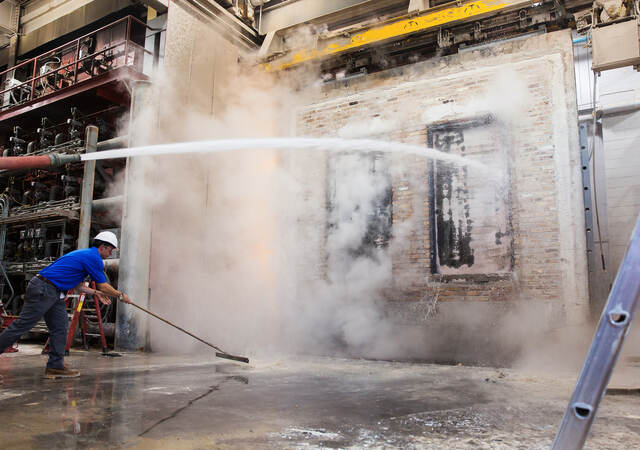
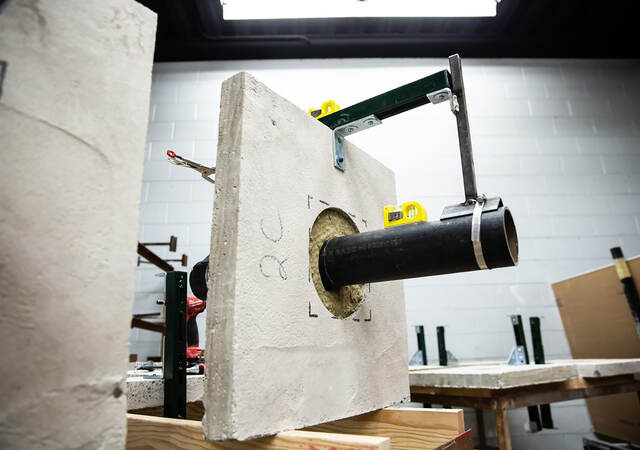
Four firestop systems — each with different penetrants and firestop materials — were installed in a Douglas fir CLT floor slab, and the same four systems were installed in a poplar CLT floor slab. To support consistent results, duplicate samples were built, resulting in two Douglas fir slabs and four poplar slabs. All six slabs contained the same four firestop systems. Using the same systems in both floor types allowed for a direct comparison of how species-related factors, such as charring rate or other material differences, might influence firestop performance. Each floor slab was fitted with thermocouples and fire tested individually in accordance with UL 1479.
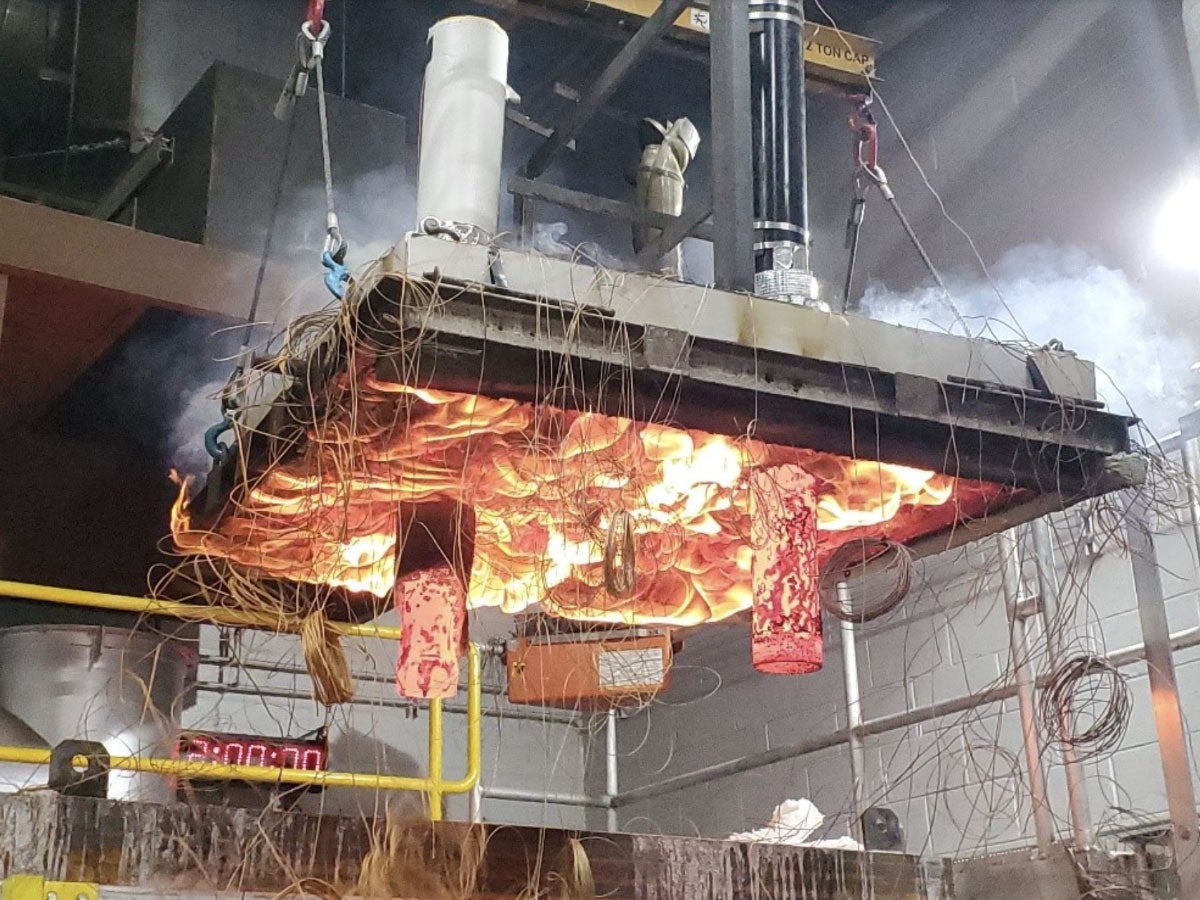
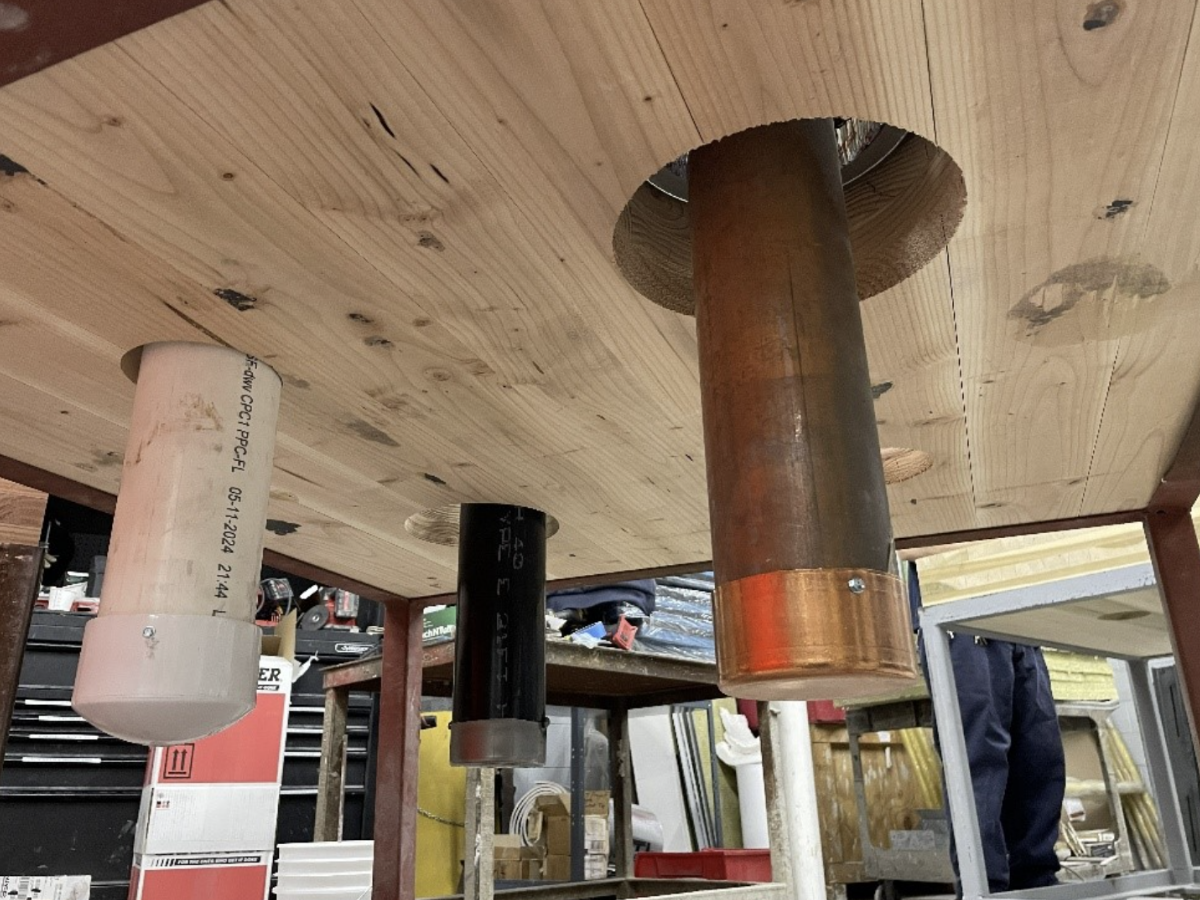
Photos illustrate the installation of the various penetrants in one of the CLT floor slabs, and the fire-exposed side of the slab at the conclusion of the fire test.
The research testing confirmed that firestop performance in CLT assemblies can be notably affected by the charring rate of the CLT species. In testing, Poplar’s much faster charring caused earlier temperature rise and earlier UL 1479 thermal-transmission failures compared with Douglas Fir, due to accelerated material loss around the penetration. The degree of sensitivity to species-dependent charring varied by firestop system, indicating that performance cannot be assumed consistent across all CLT types. These findings indicate that it is important to carefully consider and select the CLT species for fire testing ahead of time, so it is representative of the anticipated range of CLT species used in the actual construction. This is particularly relevant for firestop solutions that rely on mechanical anchorage or intumescent confinement.
UL Solutions leverages these research findings as we work closely with firestop manufacturers to develop streamlined and focused evaluation programs while achieving the broadest coverage of CLT species. This new approach serves to further enhance firestop systems with CLT and broaden the use of this sustainable building material.
Firestop systems which have been tested and certified in a fire resistive CLT floor or wall assembly can be located using the UL Solutions complimentary online certification directory, Product iQ®.
The systems include the alpha character G (for a floor assembly) or O (for a wall assembly), as the second alpha character in the fire system designation. For example, “F-G-1001” and “F-G-1002.” Alternatively, you may use the Firestop Systems enhanced search (under the Building Materials and Systems dropdown menu), and select “Cross Laminated Timber” under Assembly Type.
Additional information on CLT and firestop systems can be found on the XHEZ Guide Information Page for firestop systems, under the heading “Mass Timber Floor or Wall.”
Contact us
Email: ULRegulatoryServices@ul.com