
Author: Simon Ince, Program Manager, UL Solutions
Fire protection in data centers is more critical and complex than ever. This article will explore fire safety considerations in these high-tech facilities and discuss strategies to support the performance of fire safety systems when they are needed most.
The global data center industry is constantly pushing the boundaries of innovation in power distribution, cooling, energy storage and server technology. While these advances bring exciting opportunities, they also introduce new risks. Mitigating many of these fire risks can be supported by choosing certified fire protection systems that have been properly specified, installed and maintained.
A global industry
While the data center industry is expanding worldwide, data centers must still comply with regional fire protection standards. Building codes and regulations differ from country to country, but they generally include prescriptive and performance-based fire safety requirements designed to provide a reasonable level of life safety and some property protection. However, these regulations often lack measures specifically geared toward maintaining business continuity.
These model codes typically consider the size and complexity of a building, occupancy levels, fire load and potential fire growth rates, and require both passive and active fire protection to achieve an acceptable level of risk to life and structural property.
Regional differences in codes and approvals mean that the methods for achieving regulatory fire protection vary. Therefore, wherever a data center business operates, facilities must comply with all applicable local fire safety regulations.
Organizations such as UL Solutions support compliance with regional building codes and installation standards by providing third-party testing, inspection and certification designed to complement region-specific safety requirements.
Business continuity
Data centers operate 24 hours a day, 365 days a year. For this sector, effective fire protection strategies must also be designed to consider business continuity. Even a relatively small fire can result in significant operational disruption and financial loss.
Industry data indicates that fire disruption accounts for approximately 14% of significant outages.1 While the total number of fire-related incidents may be decreasing, global reliance on digital infrastructure continues to grow. As a result, outages are becoming more impactful and costly. The average cost of downtime can soar as high as $9,000 per minute, with large enterprises facing average costs of $540,000 per hour.2
Although major data center fires are infrequent, their consequences can be severe. In September 2025, a lithium-ion battery fire in South Korea forced the closure of a government-run data center, disrupting 647 public systems. Critical services, including tracking for emergency vehicles in Daejeon and Sejong, were temporarily paralyzed.3 The incident highlighted the vulnerability of critical digital infrastructure to fire-related events.
At the same time, the pace of digital transformation and artificial intelligence (AI) development is accelerating. Global data center construction is projected to grow by approximately 11.10% annually through 2034.4 This rapid expansion is driving innovation in design, construction methods and energy systems.
As a testing, inspection and certification provider, UL Solutions works with major data center providers to support innovation by evaluating safety performance. Regulations often struggle to keep pace with emerging technologies. When new risks arise, science-based testing and certification protocols help demonstrate conformity with existing regulations and advance safety where standards have yet to be established.
One example is UL 2755, the Outline of Investigation for Prefabricated Modular Data Center Systems and Related Modular Units, which addresses the increasing demand for prefabricated modular data centers (MDCs). Modular construction allows faster deployment than conventional builds, with modules often manufactured in one country and installed in another. Supporting code compliance during factory construction is therefore essential.
Start with a fire strategy
Early engagement with a competent local fire engineer is essential during the planning phase of a data center project. Fire engineers routinely develop life safety strategies based on a site-specific hazard mitigation analysis (HMA), but they can also incorporate resilience and business continuity measures into such strategies.
Maintaining fire engineering involvement throughout construction helps ensure that the “on paper” strategy is properly implemented. For example, many data centers rely on battery energy storage systems (BESS) to provide reliable and continuous power. These systems can provide immediate backup power until standby generators start.
Fire engineers rely on design guidance such as NFPA 855, which addresses the installation of stationary energy storage systems and requires certification to UL 9540, the Standard for Energy Storage Systems and Equipment. UL 9540A, the Test Method for Evaluating Thermal Runaway Fire Propagation in Battery Energy Storage Systems, is used to evaluate fire propagation characteristics of specific BESS. Understanding how a battery system behaves under fire conditions is essential to managing that risk.
Design with function in mind
In addition to fire engineers, specialist designers for active fire protection, such as detection and suppression, along with passive fire protection for fire containment, should be involved early in the planning process. For example, within the Royal Institute of British Architects (RIBA) Plan of Work, Technical Design is traditionally completed at Stage 4. However, introducing detailed fire protection considerations during Stage 2 (Concept Design) can help identify and resolve potential fire protection issues early in construction.
Data centers contain extensive building services, such as power cables and air conditioning duct work, that penetrate fire-resisting compartments, and how these services pass through fire-separating elements, while still maintaining fire separation is crucial.
Specialist designers understand the importance of third-party certification and selecting systems with verified performance. Tools such as Product iQ® allow designers to confirm the tested scope and application of products. Matching certification data to real-world installation conditions helps prevent costly remedial work later.
Protect, detect, and suppress
Active and passive fire protection systems must perform reliably when required. Selection should be based on verified performance testing, as failure during a fire event could result in significant and costly downtime.
Structural fire resistance and compartmentation are fundamental to any onsite fire protection strategy. Standards such as UL 263, the Standard for Fire Tests of Building Construction and Materials (also recognized as ASTM E119), support the evaluation of structural stability and fire separation. Separating plant rooms from server halls, for example, limits fire spread and protects critical assets.
Early fire detection is equally important. Data centers typically have high airflow due to cooling requirements, making traditional detection less effective. Aspirating smoke detection systems, which continuously sample air near server racks, provide very early warning. UL 268, the Standard for Smoke Detectors for Fire Alarm Systems, specifies performance requirements for these detection systems.
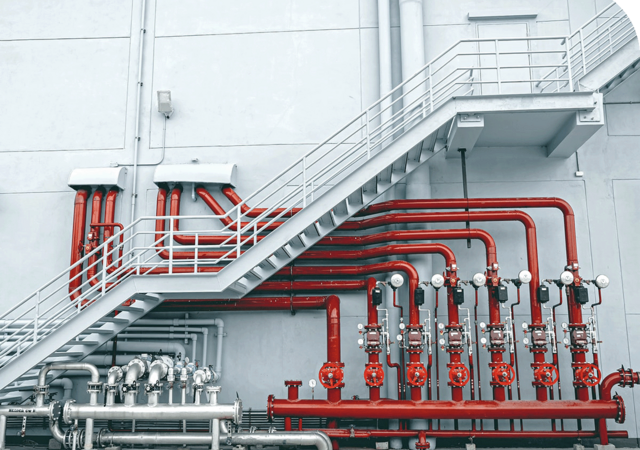
Fire suppression systems vary depending on the area and risk profile within the data center. Typically, inert gas systems and water mist systems are used in areas containing sensitive electrical equipment. Regardless of the type of system chosen, the components and system should have been tested and certified to be suitable for the specific on-site risk scenario they are intended to mitigate.
Competence matters
Specifying tested and certified products is only part of the solution. Improper installation can undermine even the best-designed systems. Installer competence should be established before work commences to avoid costly and disruptive remediation. Schemes such as the UL Solutions Qualified Fire Stopping Contractor Program can support due diligence in selecting competent specialist contractors.
In a sector where uptime is paramount, fire protection must be approached holistically. From building design and fire strategy through product selection and installation, each stage must be synchronised to protect life and to support business continuity. Therefore, the competence of all involved must be specified and vetted. As digital infrastructure continues to expand, competent specialists equipped with third-party verified fire safety solutions can help drive safer, more reliable data center operations.
Ongoing management, testing and maintenance
Getting the design, specification and installation of fire protection systems right, helps reduce the risk of downtime from day one. However, without ongoing inspection, testing and maintenance of fire safety systems, even the best systems may not function as intended over time. Many data center providers implement externally audited business continuity management systems, such as ISO 22301 or rely on data center–specific guidelines such as UL 3223, the Outline of Investigation for Data Center Certification. Documented, audited processes for fire risk mitigation can provide a proactive approach to maintaining the fire protection system in a data center.



References
Taken from the Uptime Institutes 2025 report, Executive summary: Uptime Institute Global Data Center Survey 2025
Uptime Institute 2025 report, Annual outage analysis 2025 | Uptime Intelligence
Source: The Independent Newspaper online post 27th September 2025, South Korea scrambles to restore services after massive fire hits central government data center | The Independent
Fortune Business Insights report 20th Feb 2026, Data Center Market Size, Share & Trends Outlook, 2034
Get connected with our team
Our testing, certification and field-based services for fire resistance and suppression, access control, security and emergency response can help you show compliance and adapt to evolving conditions.