By: Ben Gaudet, P.E., R&D manager, Fire Research and Development, UL Solutions, Distinguished Member of Technical Staff – William Henry Merrill Society
As deployment of battery energy storage systems (BESS) accelerates worldwide, fire and explosion safety has become a defining challenge for the industry. While these systems are beneficial to the energy transition, a series of high-profile fire and explosion incidents has intensified scrutiny from regulators, project developers, manufacturers and code authorities. In response, the industry is converging on a shared understanding: sustained market growth and public confidence depend on safety validation grounded in science, rigorous testing and robust engineering analysis.
Under the leadership of its Applied Science and Innovation, Regulatory Services and Energy Storage teams, UL Solutions has developed an integrated approach to BESS safety that combines standardized testing, fire and explosion code compliance analysis and advanced simulation techniques. Together, these elements support both safety and efficient market entry, while addressing the increasingly complex risk profile of modern energy storage installations.
The evolving codes and standards
Recent updates to model BESS safety codes and standards reflect an evolution in how the industry recognizes and addresses the specific fire and explosion hazards posed by lithium-ion-based energy storage systems. The 2026 edition of the National Fire Protection Association (NFPA) 855 introduces more explicit requirements for assessing fire hazards and reducing explosion hazards. The 2026 edition requires a large-scale fire test for all lithium-ion BESS, recognizing the eventuality of BESS fires and a need to directly valuate this scenario. Regarding explosion hazards, BESS are now required to comply with analyses in accordance with NFPA 68 and NFPA 69, both of which are well-established explosion protection codes in the process safety industry. NFPA 68 establishes criteria for pressure relief vent sizing, placement and performance to show that deflagration overpressures can be safely relieved without structural failure. NFPA 69 addresses system strategies such as combustible concentration reduction systems (CCRS), which reduce explosion risk by reducing available fuel.
Along with evolving model codes, UL 9540A, the Standard Test Method for Evaluating Thermal Runaway Fire Propagation in Battery Energy Storage Systems, evaluates thermal runaway and fire behavior of BESS and testing has been recently updated with significant changes at the installation level. The revised test protocols evaluate large-scale fire behavior, reflecting the similar changes in NFPA 855. Performance criteria for this testing focus on prevention of fire and thermal runaway spread from an initiating BESS container to nearby target containers in the end-state installation configuration. These changes to the requirements in NFPA 855 and UL 9540A provide clearer expectations for system designers and code authorities. As a result, code authorities are also increasingly requesting comprehensive fire and explosion analyses as part of permitting and approval processes.
Integrated safety assessments
To help manufacturers and developers navigate this evolving landscape, UL Solutions offers coordinated assessments aligned with NFPA 855 and UL 9540A. Rather than treating these requirements in isolation, our approach evaluates how installation design, prevention strategies and protection measures interact at the system level. An NFPA 855 assessment applies a structured, developed checklist developed by UL Solutions to evaluate a BESS installation against the standard’s requirements. The resulting documentation provides a clear system description, an executive summary of findings, and a detailed, requirement-by-requirement evaluation. These assessments often form the backbone of a permitting submittal, helping reduce uncertainty during the approval process.
For explosion hazard prevention and control, NFPA 69 and NFPA 68 assessments are required to be performed in accordance with NFPA 855. UL Solutions provides these assessments using computational fluid dynamics (CFD) performance-based analysis. We apply advanced CFD tools such as Fire Dynamics Simulator (FDS) to evaluate explosion prevention strategies per NFPA 69 and Flame Acceleration Simulator (FLACS) to assess vented deflagration scenarios per NFPA 68. These engineering analyses apply UL 9540A gas composition data, gas generation data and knowledge of the BESS design to estimate the effectiveness of specific CCRS and deflagration relief devices under representative scenarios. For example, the NFPA 69 and 68 analyses assess, respectively, the effectiveness of a CCRS to prevent gas accumulation and of deflagration panels to relieve overpressure from ignition of an accumulated flammable gas mixture. In each case, the foundation of these analyses is UL 9540A test data, which is collected and analyzed by UL Solutions testing laboratories.
Large-scale fire and deflagration testing
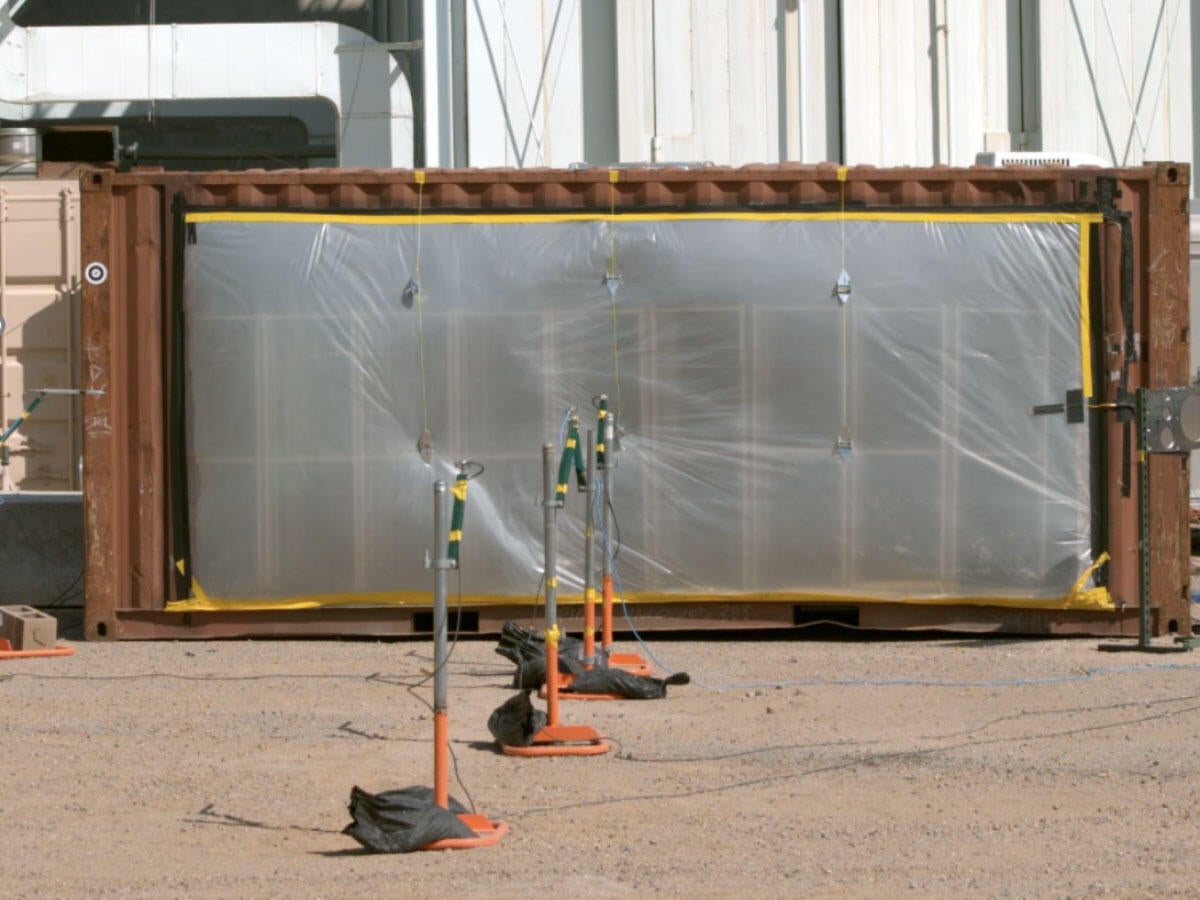
The revised UL 9540A installation-level testing reflects the need to evaluate realistic, worst-case scenarios. Large-scale fire testing is designed to demonstrate that thermal runaway, followed by ignition of evolved flammable gases and a fully developed fire condition, will not result in fire spread beyond the originating BESS enclosure. Large-scale deflagration testing, as defined in Annex C of UL 9540A, is a pathway to define credible ventilation conditions for the large-scale fire test. It is assumed that ignition of thermal runaway effluent gases before a fire condition develops is likely to cause overpressures that open pressure relief panels and, in some cases, doors or other openings. In all cases, the air supply available to generate a fire condition is affected. Both test methods per UL 9540A are the foundation of installation-level BESS safety. They also satisfy prescriptive requirements of NFPA 855 for fire and explosion testing of lithium-ion BESS.
Simulation in BESS safety engineering
Simulation approaches such as CFD and machine learning are becoming an informative complement to physical testing. Modeling and simulation enable engineers to explore alternate or worst-case scenarios, evaluate design sensitivities and inform safety strategies across multiple levels of BESS architecture.
At the cell level, models capture thermal runaway chemical kinetic mechanisms and internal temperature rise. These simulations aim to characterize heat release rates, venting behavior and gas composition, providing essential source term data for higher-level analyses. At the module level, interactions between cells become the primary concern. Simulation can estimate heat transfer pathways, the effectiveness of thermal barriers, the timing and severity of off-gassing, and the conditions under which thermal runaway may propagate from one cell to another. While uncertainties remain, simulations allow engineers to examine conservative scenarios and assess their implications for overall system safety.
At the installation level, simulation supports macro-scale design and layout decisions for a BESS installation that are directly relevant to NFPA 855 compliance and UL 9540A large-scale testing performance. Models are primarily used to help estimate heat transfer and separation distances from one BESS container to another based on the impact of combustible loading, container design and lithium-ion cell type. Simulation and modeling at these different scales inform design optimization and test planning. They also help to reduce risk and cost by helping to identify issues earlier in the development cycle.
A unified pathway to compliance
BESS are central to global energy transition goals, but their successful deployment depends on addressing safety challenges with rigor and transparency. As the energy storage industry evolves, project teams face challenges in navigating the changing safety codes, standards and code authority interpretations. One of UL Solutions’ goals is to simplify this landscape by integrating testing, compliance assessments and engineering analyses into a coherent compliance strategy. By combining UL Solutions testing, assessments to NFPA standards, advanced CFD simulation and expert engineering interpretation, UL Solutions provides a unified pathway to help customers navigate safety compliance, approvals and project risk.
Contact us
Email: ULRegulatoryServices@ul.com