Authored by: Frederick P. Reyes, principal engineer, Special Protection Devices, UL Solutions, Distinguished Member of Technical Staff, William Henry Merrill Society and Michal Hofkin, lead regulatory engineer, UL Solutions
The 2026 edition of NFPA 70®, the National Electrical Code® (NEC), was issued by the National Fire Protection Association (NFPA®) Standards Council on Aug. 20, 2025, with an effective date of Sept. 9, 2025. Numerous significant changes were made to the latest NEC®, including a new definition for special purpose ground-fault circuit interrupters (SPGFCIs) and new definitions of Class C, Class D, and Class E GFCIs. The permitted use of this technology has been expanded.
UL 943C, the Outline of Investigation for Special Purpose Ground-Fault Circuit-Interrupters, covers ground-fault circuit-interrupters intended for use either:
- Where the voltage to ground is greater than 150 volts, and the NEC requires equipment grounding or double insulation.
- Where the voltage to ground is 150 volts or less and equipment grounding or double-insulation is provided, but the use of a Class A ground-fault circuit interrupter is not practical.
The SPGFCI class of GFCIs trips when the current to ground is within the range of 15 to 20 mA. A class C GFCI may have a threshold of greater than 6mA to 15mA to provide limited let-go protection. These classes of GFCIs rely on a supplemental, layered approach to protection, using the presence of an equipment grounding conductor as part of the protective scheme. SPGFCIs monitor the presence and integrity of the grounding circuit path to the load through a ground monitor/interrupter (GM/I). An unacceptable increase in the grounding path resistance, or loss of the grounding path, will cause the circuit to the load to be interrupted.
A person touching the protected equipment and earth will have a reliable, low-impedance equipment grounding path in parallel with the person's body, resulting in an indirect fault where the majority of the fault current bypasses the body. For Class C circuits with potentials greater than 150 V to earth, oversized grounding conductors are required, along with a GM/I, to maintain a low impedance path that limits the maximum potential to 150 V AC to earth. For Class D and Class E circuits, with potentials more than 300 V to earth, high-speed tripping is required in addition to GM/I and oversized a grounding-impedance path that limits the maximum potential to 150 V AC to earth. For Class D and Class E circuits, with potentials more than 300 V to earth, high-speed tripping is required in addition to GM/I and oversized grounding.
The recent introduction of high frequency (HF) rated and marked GFCIs in UL 943 provides optional performance requirements for evaluating GFCIs intended for use with loads that produce modern high-frequency leakage currents, such as those from variable speed drives and inverters. This HF rating may be applied to Class C, Class D and Class E GFCIs.
Understanding GCFI classes in UL 943
Class A GFCI
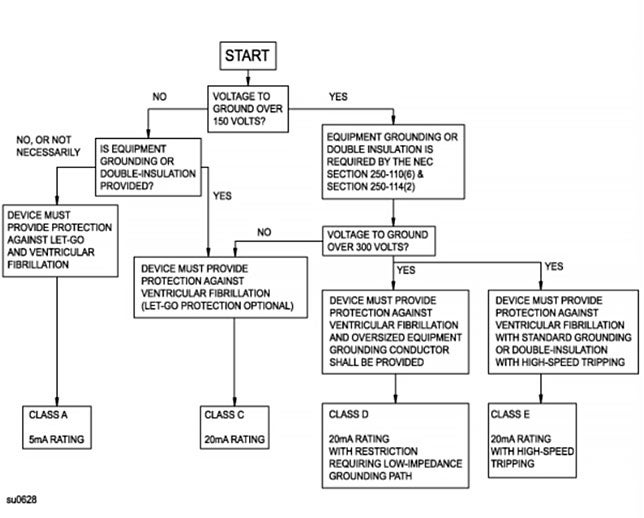
The requirements for Class A ground-fault circuit interrupters are in UL 943. These ground-fault circuit interrupters are intended to be applied to circuits as shown below.
Figure 1.1
Application of GFCIs
The definitions of the different classes of SPGFCIs are critical to understanding their usage:
Class C GFCI
A ground-fault circuit interrupter that is intended to be used in circuits with no conductor over 300 V AC to ground where reliable equipment grounding or double insulation is provided.
Class D GFCI
A ground-fault circuit interrupter that is intended to be used in circuits with one or more conductors over 300 volts to ground, and with specially sized, reliable grounding, to provide a low impedance path so that the voltage across the body during a fault does not exceed 150 volts.
Class E GFCI
A ground-fault circuit interrupter that is intended to be used in circuits with one or more conductors over 300 volts to ground but with conventional equipment grounding provided for the protected equipment in the system or double insulation. These ground-fault circuit-interrupters respond rapidly to open the circuit before the magnitude and duration of the current flowing through the person’s body exceed the limits for ventricular fibrillation.
Specific installations
Section 210.8(F) has a new Exception No. 3 that permits the use of a Class C SPGFCI for listed HVAC equipment at dwelling units. If a Class C SPGFCI is provided, the disconnect serving the HVAC equipment shall be marked “Warning: Class C SPGFCI Protection Provided for HVAC Unit.” An information note raises awareness for SPGFCIs with HF ratings.
Article 410, in Part XV, Special Provisions for Horticultural Lighting Equipment, Section 410.184(B), requires a listed SPGFCI with a ground-fault trip current not exceeding 20 mA for single- or three-phase circuits exceeding 150 volts to ground to protect the outlets for lighting equipment identified for horticultural use and employing flexible cords with one or more separable connectors or attachment plugs. SPGFCI protective equipment that is listed only for use with protected equipment that employs a double insulation system shall not be used for this purpose.
The following NEC Articles also contain new requirements for the use of SPGFCIs:
- Article 626, Electrified Truck Parking Spaces
- Effective Jan 1, 2029, SPGFCI protection is required for all receptacle outlets supplying transport refrigerated units, supplied by branch circuits that are rated more than 150 volts to ground, 100 amperes or less.
- Article 680, Swimming Pools, Fountains, and Similar Installations
- Ground-fault protection of receptacles and outlets on branch circuits operating above 150 volts to ground, not exceeding 480 volts phase-to-phase, single- or 3-phase, shall be provided with SPGFCI protection not to exceed 20-mA ground-fault trip current.
- SPGFCI protection has been expanded into equipment rooms, vaults, and pits.
- SPGFCI protection now applies to permanently installed heaters for permanently installed immersion pools.
There are some exceptions to the rules above. A thorough reading of the code is recommended.
Product iQ®

Special purpose ground-fault circuit interrupters may be certified (listed) by UL Solutions under the product category Special Purpose Ground-Fault Circuit Interrupters (product category KCYC) for compliance with UL 943C, the Outline of Investigation for Special Purpose Ground-Fault Circuit-Interrupters. The guide information and UL Certified (Listed) products can be viewed on Product iQ®, a complimentary database of certification information.
This article contains excerpts and paraphrasing from the 2026 edition of NFPA 70® National Electrical Code®.