
Today, both enterprise-level and product-level emissions data are no longer optional — they are required to comply with regulations, meet investor expectations, and satisfy customer demands. Organizations across industries have made efforts to measure and collect product carbon footprint (PCF) or value chain (Scope 3) data. The motivation is clear: sustainability performance improvement, regulatory disclosure, investor scrutiny and customer expectations all demand deeper transparency into emissions sources than simple spend-based analysis allows. However, even among companies that do manage to collect substantial PCF data, momentum often runs out after the initial data collection. Once suppliers have been surveyed and emissions calculated, the critical question emerges: what comes next?
Turning PCF data into action
The answer lies in turning data into action. The value of PCF data doesn’t come from the spreadsheet itself but from how it is translated into operational insight and strategic decisions. When leveraged effectively, PCF data can help companies optimize their supply chain, improve product design and material choices, and guide product redesigns and procurement strategies that drive both emissions reduction and business resilience.
From measurement to momentum
Once PCF data is available, organizations need to turn those raw numbers into actionable insights. A core output of this process is identifying data gaps alongside surfacing the disproportionate hot spots in the footprint, such as key suppliers, materials, logistics flows or manufacturing processes that account for significant emissions. These hot spots become strategic levers for action.
This is also the moment to embed PCF data into decision-making frameworks such as sourcing strategy, product design considerations, logistics optimization and supplier contract design. Incorporating PCF data into your organization’s operating rhythm not only eases future compliance exercises but also enables value creation and competitive advantage.
Where carbon intelligence drives transformation
With granular data from suppliers and across processes, several high-impact levers become accessible:
- Supplier engagement and substitution – Identifying suppliers whose operations or materials contribute large portions of the footprint opens opportunities to engage them in improvement programs — or to consider alternative sourcing from lower-carbon suppliers.
- Material and product redesign – Many studies confirm that upstream material choice or early-phase manufacturing dominate emissions. By redesigning products, substituting lower-carbon materials, increasing recycled content or shifting manufacturing methods, organizations can capture meaningful reductions (Sappinen et al., 2025).
- Operational efficiency and energy transition – Data often reveals inefficiencies in manufacturing energy use, process heat or facility operations. Integrating renewable energy sourcing, electrifying process equipment or improving asset utilization can significantly cut emissions across owned and supplier operations while also improving profitability (IEA, 2021).
- Logistics and network configuration – Rethinking transport modes, consolidating freight, optimizing packaging or regionalizing supply chains can cut emissions and save on associated costs. For instance, transportation accounts for over 80% of the carbon footprint in cold chain logistics (Li et al., 2025).
- Circularity and end-of-life innovation – Product footprint data can reveal where waste, recycling or reuse loops can close the carbon gap. Designing for disassembly, increasing recyclability and building reverse-logistics channels support emissions reduction and resource resilience (Ellen MacArthur Foundation, 2023).
- Multi-objective trade-offs and modeling – Research shows that when supply chain models incorporate carbon alongside cost, organizations can explore trade-offs (e.g., slightly higher sourcing cost for much lower emissions) and create a clear decarbonization road map to help differentiate them from competitors (Benjaafar, n.d.).
When viewed this way, product footprint data becomes a strategic asset to guide sourcing, design, logistics and risk decisions.
Turning insight into impact
Collecting and analyzing data is technically demanding, but acting on it is an organizational challenge. When expertise is missing, advisory services can bridge the gap. Specialists help translate emissions data into coherent decarbonization road maps by benchmarking performance against peers, prioritizing reduction levers, designing governance frameworks and aligning cross-functional teams across procurement, product design, operations and sustainability.
Advisory support can also help organizations build a business case for carbon action by linking emissions improvements to cost savings, risk reduction, supplier innovation and brand value. The result is not simply emissions reduction — it’s measurable enterprise value.
Technology as the catalyst, not the destination
Software platforms for carbon accounting, supply chain footprint modeling and analytics are now foundational. But the organizations that realize the most value from their software investments treat software as an enabler, not the destination. The real differentiator is embedding the tool into decision workflows: source-to-contract, product-design gates, logistics planning. The models should support scenario simulation (e.g., “What happens if we switch to supplier X? What if we redesign material Y?”) and integrate seamlessly into procurement and supply chain systems.
However, simply deploying a tool is not enough. The real impact comes from how insights are operationalized and how behaviors and decisions evolve across the organization.
The value engine of carbon intelligence
When organizations move from data collection to strategic deployment of product footprint insights, the payoff becomes clear:
- Risk reduction and regulatory preparedness – With credible footprint data, organizations are better positioned for emerging regulations and assurance requirements. Research shows that upstream supply chain emissions may need to decline by over 50% in many sectors to align with a 1.75 C warming scenario (Li et al., 2020). When jurisdictions adopt stronger climate measures, companies that already have strong supply chain data and have already done the work to reduce their supply chain emissions can realize significant benefits.
- Cost and efficiency gains – The highest-emitting suppliers or processes often also reflect operational inefficiencies. Optimizing for carbon frequently unlocks cost savings.
- Supplier innovation and engagement – Engaging suppliers on their footprint can help build capability, unlock innovation and strengthen partnerships for a lower-carbon future.
- Brand and stakeholder trust – Demonstrating that PCF data drives action — not just reporting — builds credibility with investors, customers and regulators.
- Resilient supply chain architecture – Carbon-aware supply chain design, such as regional sourcing or mode shifting, can help strengthen resilience by reducing exposure to disruptions, regulatory shocks and carbon-price risks.
From compliance to competitive edge
Measurement remains foundational; you cannot act without credible data, but it is only the beginning. The next step is embedding that data into the fabric of supply chain decisions: sourcing, design, logistics and supplier collaboration.
Leaders treat PCF data the way they treat cost and quality metrics, as live inputs that influence decisions every day. They rely on software to surface insights and advisory expertise to embed change. And they recognize that carbon-optimized supply chains are not only good sustainability practice but also a strategic advantage.
The question is no longer just “Do we have the data?” but “What are we doing with it?”
How UL Solutions can help you turn data into decarbonization advantage
UL Solutions supports organizations in transforming PCF data into strategic action. Through our integrated software and advisory services, we help businesses move beyond measurement to meaningful impact.
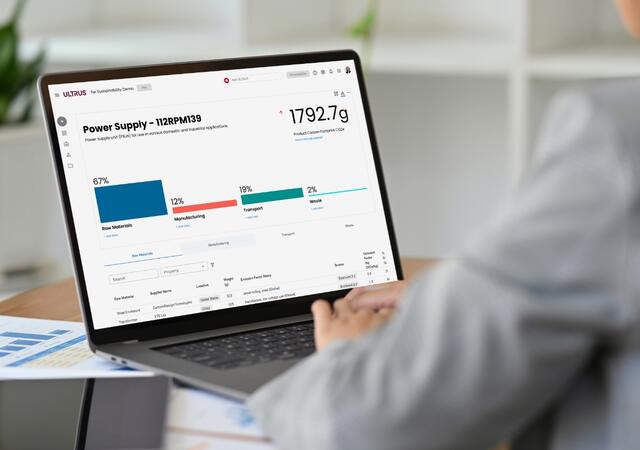
Our ULTRUS™ Enterprise Sustainability software portfolio helps streamline PCF reporting with AI-powered bill of materials (BOM) processing, automated emissions calculations and supplier tools. It integrates with existing systems to reduce manual effort, improve data accuracy and accelerate decision-making.
Complementing the software, our sustainability advisory services provide expert guidance to help standardize methodologies, validate supplier data, and align PCF strategies with regulatory frameworks and decarbonization goals. Together, these capabilities enable organizations to embed carbon intelligence into sourcing, design and operations — unlocking emissions reductions, cost efficiencies and long-term resilience.

Get connected with our sales team
Thanks for your interest in our products and services. Let's collect some information so we can connect you with the right person.