
Procurement’s new strategic role
Procurement has long been seen primarily as a function focused on cost control and supplier management. Yet in today’s sustainable business environment, the role of procurement is evolving rapidly. With Scope 3 emissions accounting for up to 80% of many companies’ greenhouse gas footprint — and according to CDP, up to 70% of those emissions are from purchased goods and services — procurement has great influence over a company’s emissions footprint and great power to help drive corporate decarbonization. Procurement executives are uniquely positioned to transform their function from a cost-focused gatekeeper into a strategic driver of an organization’s sustainability. By leveraging product carbon footprint (PCF) insights tied to individual items, components and suppliers, procurement teams can reduce emissions, mitigate risk, protect supply continuity, bolster brand reputation, and unlock operational and financial value (Strategy&, 2024).
Understanding Scope 3 and procurement’s leverage
Scope 3 emissions — indirect emissions that occur in a company’s value chain — are often the largest contributor to an organization’s overall carbon footprint. These include emissions from purchased goods and services, transportation, and product use, among others (EPA, n.d.). For many industries, purchased goods alone can account for 35%-40% of Scope 3 emissions (Deloitte, 2023). Procurement controls sourcing decisions, supplier relationships, contract terms and category strategies, meaning it is well-positioned to strategically address these emissions. However, visibility into the sustainability of the supply chain, particularly beyond Tier 1, is often limited, leaving companies blind to their largest carbon hot spots (Accenture, 2022). The imperative for the C-suite is clear: To decarbonize a business, procurement must embed sustainability into the heart of supplier strategy.
Leveraging product-level carbon footprint data
PCFs offer the actionable insight procurement teams need to drive decarbonization. PCFs quantify the greenhouse gas emissions generated across a product’s full life cycle — from raw material extraction through manufacturing, transport, use and end of life (Center for Sustainable Systems, University of Michigan, 2025). By considering this data, procurement leaders can identify which suppliers or products are responsible for the largest portions of an organization’s purchased-goods emissions, prioritize reduction initiatives for those suppliers and products, and make sourcing decisions that consider both cost and carbon intensity. Research confirms that PCFs are essential for sustainable procurement, providing a measurable, decision-ready perspective on supply chain emissions (Thanawala, 2024). With this level of granularity, procurement can move from reactive compliance to proactive strategic decision-making.
Embedding carbon metrics in supplier contracts and KPIs
Data alone doesn’t drive change. Procurement teams must convert insights into action via contract clauses, supplier engagement and measurable KPIs. Most effective practices include embedding emissions reduction targets in contracts, incentivizing low-carbon alternatives and tracking supplier performance over time. Dashboards and scorecards allow procurement to monitor progress, while collaboration transforms suppliers into partners rather than merely vendors. Research shows that structured supplier engagement and incentives can significantly improve sustainability outcomes (Butt et al., 2024).
Strategic benefits of carbon-informed procurement
Adopting a carbon-informed procurement strategy delivers multiple benefits. Risk mitigation is immediate: Companies that fail to address Scope 3 emissions may face regulatory penalties, investor scrutiny or reputational damage, particularly in regions like the EU where disclosure requirements are expanding (PwC, n.d.). Cost optimization is another advantage, as high-emission suppliers often correlate with resource-intensive, high-waste processes. Switching to lower-carbon alternatives can reduce material costs, energy consumption and supply chain risk. Beyond operations, procurement-driven decarbonization bolsters sustainability credibility, creating measurable proof of climate action that strengthens brand reputation and supports investor confidence. Additionally, this approach can spark innovation and competitive advantage, as low-carbon sourcing enables product redesign, new supplier partnerships and access to new markets.
Operationalizing carbon insights
To make carbon-informed procurement a reality, organizations require reliable, granular and actionable product-level carbon data. Modern analytics tools allow teams to integrate emissions insights into sourcing decisions, supplier scorecards and category strategies. Critical capabilities include product-level granularity, supplier-specific data, scenario analysis and alignment with international standards, such as the Greenhouse Gas (GHG) Protocol Product standard or other frameworks (World Resources Institute and World Business Council for Sustainable Development, 2011). When procurement teams have the right data at their fingertips, they can make informed decisions that balance cost, quality and climate impact, transforming procurement into a strategic driver of corporate sustainability.
Conclusion: Turning procurement into climate leadership
With regulatory, investor and stakeholder pressures mounting, and large amounts of emissions often hidden upstream in the supply chain, you cannot afford to leave procurement on the sidelines. By leveraging product-level carbon insights, embedding carbon metrics into contracts and key performance indicators (KPIs), and positioning procurement as a strategic partner in decarbonization, organizations can turn supply chain emissions from a risk into a competitive advantage. For C-suite procurement executives, the question is no longer whether to act but how quickly and effectively carbon intelligence can be embedded into every sourcing decision. The companies that rise to the challenge not only reduce emissions but also strengthen supply chain resilience, drive innovation and establish themselves as leaders in the low-carbon economy.
How UL Solutions supports carbon-informed procurement
UL Solutions empowers procurement teams to operationalize product carbon intelligence across sourcing decisions, supplier engagement and contract strategy. Our integrated software and advisory services help organizations move from emissions visibility to measurable impact.
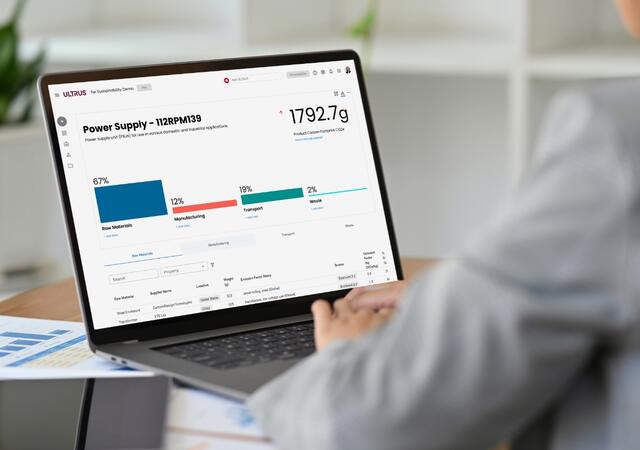
ULTRUS™ Enterprise Sustainability software portfolio enables procurement leaders to access product-level emissions data with AI-powered bill of materials (BOM) processing, automated PCF calculations and supplier-specific insights. It integrates seamlessly with existing systems to help reduce manual effort, improve data accuracy and support scenario modeling across sourcing options.
Paired with our sustainability advisory services, organizations gain expert support in standardizing PCF methodologies, validating supplier data and embedding emissions metrics into procurement workflows. UL Solutions helps procurement teams align carbon reduction goals with business strategy — supporting cost savings, resilience and climate leadership.


Get connected with our sales team
Thanks for your interest in our products and services. Let's collect some information so we can connect you with the right person.