By Michal Hofkin, Lead Regulatory Engineer
The 2026 edition of NFPA 70® National Electrical Code® (NEC®) was issued by the National Fire Protection Association (NFPA®) Standards Council on Aug. 20, 2025, with an effective date of Sept. 9, 2025, with many significant changes from the previous edition. One of the more notable changes was the introduction of high-frequency (HF) rated ground-fault circuit-interrupters (GFCIs).
A new Informational Note No. 2 in the NEC Section 210.8 was added to reference UL 943, Ground-Fault Circuit-Interrupters. For more information about GFCIs marked “HF,” see Product iQ® GFCI-related guide cards (DKUY and KCXS). Class A GFCIs marked “HF” have been evaluated for use with loads that have modern-day high-frequency leakage currents from power conversion components such as variable speed drives and inverters. Such power conversion technologies are widely used to meet energy efficiency requirements and are commonly found in many of today’s appliances, such as refrigerators, heating, ventilation, and air-conditioning (HVAC) equipment, and washing machines, among others.
Certain refrigerators and HVAC appliances have demonstrated compatibility issues with GFCI protective devices. To address these concerns, UL Solutions established two task groups to comprehensively analyze the root causes of unwanted tripping with the goal of developing a consensus standard proposal to mitigate such events.
The task groups involved were UL 101 Leakage Current Task Group and the UL 943 GFCI Task Group. (UL 101 is the Standard for Leakage Current for Utilization Equipment; UL 943 is the Standard for Ground-Fault Circuit-Interrupters.) Each task group consisted of representative members from the Association of Home Appliance Manufacturers (AHAM), the National Electrical Manufacturers Association (NEMA), UL Solutions and the interested technical committee members.
The UL 943 Technical Committee tested Class A GFCIs from 10 manufacturers with various appliances. The results showed that some of the appliances had interoperability issues with various GFCI devices. Not all the GFCI devices demonstrated interoperability issues, but enough of the samples behaved in an undesirable manner to warrant changes to UL 943.
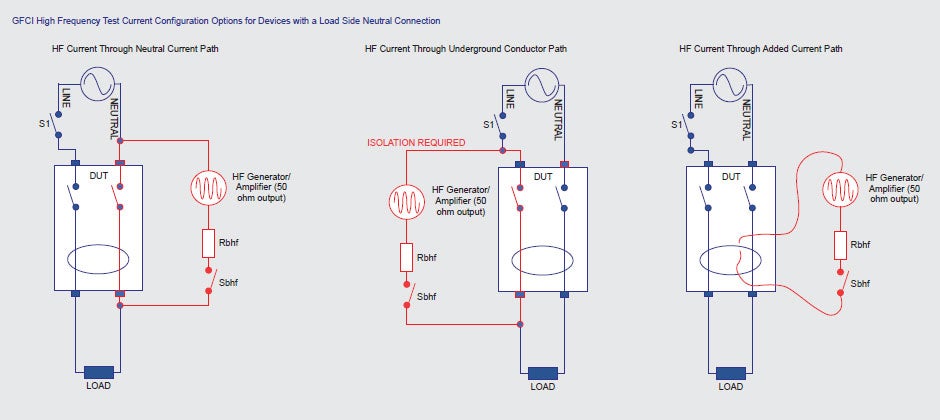
In August 2025, UL Standards & Engagement (ULSE) issued a revision to UL 943. This revision introduces Supplement SB — Optional High Frequency — HF Rating, which establishes a supplemental test procedure for GFCIs. These requirements address GFCI immunity performance in the presence of high-frequency signals, supporting compatibility with utilization equipment evaluated to the GFCI Interoperability Test of UL 101.
UL 943, Ed. 5. GFCI high frequency test current configuration options for devices with a load side neutral connection.
The 2026 NEC recognizes a new Class A GFCI type, evaluated for immunity to differential (ground) currents below 4IIU across the 60 Hz to 150 kHz range. For appliances with high-frequency leakage currents from power conversion components such as variable frequency drives or inverters, a Class A GFCI device marked “HF” may be used.
The applicable standard is UL 943, the Standard for Ground-Fault Circuit-Interrupters. UL Solutions certifies (lists) Ground-Fault Circuit-Interrupters under the product category for Ground-Fault Circuit-Interrupters (KCXS), and the product category for Circuit Breaker and Ground-fault Circuit Interrupters (DKUY). UL Solutions guide information and certifications (listings) can be viewed on Product iQ. Enter “KCXS” or “DKUY” in the search field.
NOTE: Sections of this article's contents are paraphrased from:
- UL Solutions. (2023, April). Study of high-frequency spectrum for 120 V household appliances. UL Solutions.
- UL Standards & Engagement. (2025). UL 943: Standard for safety for ground-fault circuit-interrupters (5th ed.). UL Standards & Engagement. Retrieved from https://www.shopulstandards.com/ProductDetail.aspx?productId=UL943
- National Fire Protection Association. (2025). NFPA 70®: National Electrical Code® (2026 ed.). Quincy, MA: National Fire Protection Association.
Contact us
Email: ULRegulatoryServices@ul.com