Emerging Risks in AI Data Centers
44 MB
Electrical, Thermal, Fire and Cybersecurity Challenges in Next-Generation AI Data Center Infrastructure
By Ken Boyce, Vice President, Principal Engineering | Industrial, UL Solutions
In AI data centers, electrical, thermal, fire, cybersecurity and operational risks are increasingly interdependent, making system-level interactions as important as individual component performance. This article examines how data center risks are evolving across power, cooling, fire, cybersecurity and supply chain domains — and what coordinated standards, evaluation and ecosystem alignment mean for organizations building and operating AI infrastructure at scale.
As AI data centers scale rapidly, so do the risks they introduce. High-density infrastructure is pushing the limits of electrical distribution, liquid cooling technologies are transforming thermal management, and cyber-physical convergence is creating new interdependencies that require greater system-level thinking.
Traditional data center architectures relied on relatively predictable load profiles, lower operating voltages and moderate power densities. In contrast, AI workloads are characterized by:
AI workloads introduce rapid load changes, high instantaneous current requirements and sustained high-load operation. To support these demands, data center electrical architectures are evolving toward greater efficiency, scalability and resilience through increased use of medium-voltage distribution, fewer conversion stages, distributed redundancy, battery energy storage systems and emerging higher-voltage direct current (DC) approaches.
These workloads are driving orders-of-magnitude growth in rack-level power density. AI data center deployments that commonly operated at approximately 10 kW per rack in 2020 are evolving toward architectures that industry road maps suggest could approach 1 MW per rack by 2027-2028. In some advanced or experimental deployments, effective thermal loads can correspond to even higher equivalent densities when normalized across system boundaries.
AI data center rack density: The road map from 10 kW to 1 MW
| 2020 | 2022 | 2024 | 2026 | 2027-2028 |
| ~10 kW | ~20-40 kW | ~40-120 kW | ~100-200+ kW | 1 MW |
Illustrative representation based on publicly reported industry trends and NVIDIA's published objective of supporting 1 MW IT racks and beyond beginning in 2027.
These conditions require fundamental redesign across electrical distribution, cooling systems, fire protection and control architecture. At the same time, these systems are not developed in isolation. They are constructed from components sourced across global supply chains, with various economies providing a significant portion of advanced semiconductors, power electronics, cooling systems and materials.
The resulting infrastructure is not simply more complex; it is increasingly built as a system of systems. Evolving AI architectures are driving tighter integration between power, cooling, controls and computing infrastructure, making overall system behavior dependent on interactions across multiple interconnected systems. As a result, understanding those interactions is becoming as important as evaluating the performance of the individual components that comprise them.
Electrical infrastructure remains the foundational layer of data center operation. Under AI-driven workloads, however, the challenge is no longer simply to deliver more power. AI accelerators, dense compute clusters and increasingly integrated rack architectures are changing how power is converted, distributed, protected, isolated and maintained across the facility. These changes bring installation requirements, product safety standards and electrical work practices closer together, particularly in North American deployments governed by NFPA 70, the National Electrical Code® (NEC), and NFPA 70E, the Standard for Electrical Safety in the Workplace.
These developments should be evaluated against the applicable installation, workplace safety and product requirements, including the NEC, NFPA 70E and relevant UL Standards for power distribution, control, energy storage and ICT equipment.
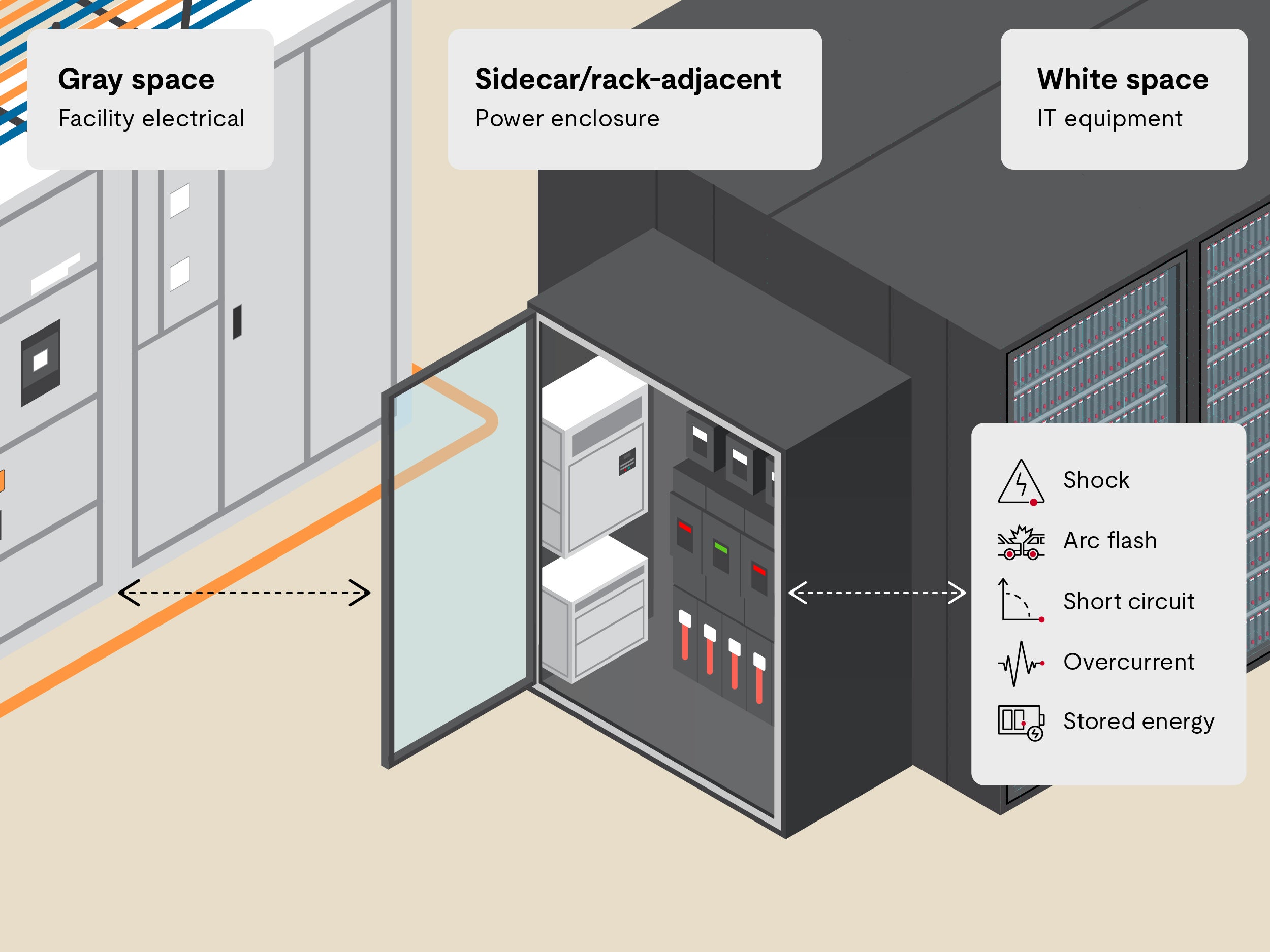
As higher-voltage distribution moves closer to IT equipment, worker exposure changes materially. Maintenance practices developed around lower-voltage or lower-energy DC systems may not be appropriate for architectures operating at 800 V DC or for future systems that may operate at even higher DC voltages. Electric shock, arc flash and arc blast risks therefore need to be assessed across the full power path, including equipment located in racks, rack-adjacent sidecars, busway systems, power shelves, converters, battery systems and other integrated enclosures.
NFPA 70E is central to this assessment. Section 130.2 establishes the baseline that energized electrical conductors and circuit parts operating at 50 V or more are to be placed in an electrically safe work condition before work is performed when a worker is within the limited approach boundary or when interaction with equipment increases the likelihood of arc-flash injury.
Energized work is therefore a controlled exception rather than a normal maintenance preference. Where energized work is justified because de-energizing introduces additional hazards or increased risk, or because the task is infeasible in a de-energized state due to equipment design or operational limitations, the work should be supported by a documented risk assessment, qualified workers, appropriate approach boundaries, arc-flash analysis, job planning, labeling, procedures and personal protective equipment (PPE).
As rack power levels increase, hot-swapping requires greater scrutiny. In higher-voltage systems, replacing a module under energized conditions can introduce shock, arcing and equipment-damage hazards unless the removable unit, connector system, enclosure, interlocks and protective devices are specifically designed and evaluated for the intended duty. Modularity should not be interpreted as permission to remove equipment under load.
Semi-hot-swapping may provide a more controlled approach where architectures reduce exposure through isolation, stored-energy management, touch-safe barriers and interlocks. Where energized work remains necessary, it should be justified and controlled rather than treated as a routine uptime requirement.
Higher power densities, redundant pathways, distributed energy resources and battery energy storage systems can increase the complexity of overcurrent protection. Overloads, short circuits and ground faults can create fire, shock, arc-flash, equipment-damage and operational-continuity risks if available fault current, interrupting ratings, short-circuit current ratings and protection coordination are not evaluated across the full fault pathway. Equipment and conductors must be able to withstand the thermal and mechanical stresses associated with the available fault current until the protective device clears the fault. Protective devices must also operate selectively so that the device nearest the fault clears the abnormal condition without unnecessarily disrupting upstream or adjacent systems.
Product categories matter in this analysis. For example, a switchboard evaluated to UL 891, the Standard for Switchboards, is not the same as metal-enclosed low-voltage power circuit breaker switchgear evaluated to UL 1558, the Standard for Metal-Enclosed Low-Voltage Power Circuit Breaker Switchgear, and the selection may affect maintainability, short-time withstand expectations, breaker architecture and protection strategy.
Furthermore, each of these standards covers different parts of the electrical system:
Selecting the correct standard for the equipment category, and then evaluating the integrated system in its installation context, is essential, as AI infrastructure places higher electrical stress on the distribution chain.
Cascading failure also requires closer attention. Dense rows of power cabinets, rack-adjacent distribution equipment, high-current bus systems and rack-level or room-level energy storage can allow a fault in one location to affect adjacent equipment if spacing, barriers, protection settings, thermal management and fault containment are not properly designed.
Battery systems evaluated under UL 9540, the Standard for Energy Storage Systems and Equipment, and tested using UL 9540A, the Standard for the Test Method for Evaluating Thermal Runaway Fire Propagation in Battery Energy Storage Systems, may need to be considered not only as standalone systems but also in relation to upstream and downstream electrical protection, ventilation, fire protection, emergency response and operational continuity.
AI clusters can create transient electrical conditions that affect voltage stability, harmonic distortion and power quality. Rapid switching of power electronics, dense GPU utilization and changing load profiles may produce load characteristics that differ from those traditionally assumed in data center electrical design. IEEE 519, the IEEE Standard for Harmonic Control in Electric Power Systems, may be relevant when assessing harmonic control, but harmonic performance is only one part of the risk picture. Designers also need to consider how fast-changing loads interact with protection settings, power conversion equipment, uninterruptible power supply systems, battery systems and the wider facility distribution architecture.
Emerging higher-voltage DC architectures introduce additional questions. Existing arc-flash analysis methods and protection assumptions have historically been shaped largely by AC systems. As 800 V DC and higher-voltage DC distribution approaches develop, further work may be required to understand DC arc behavior, arc duration, available energy, capacitive short-circuit behavior, protective device performance and the conditions under which a fault could propagate across closely integrated equipment.
These are not merely theoretical issues; they affect connector design, maintenance procedures, equipment spacing, barriers, labeling, PPE selection and emergency response planning.
As electrical distribution equipment, power electronics and IT infrastructure become more integrated, the traditional distinction between gray space and white space becomes less useful as a safety boundary. Sidecar architectures and rack-adjacent power enclosures may change where equipment is located, but they do not remove the underlying shock, arc, short-circuit, overcurrent or stored-energy hazards. Electrical requirements should therefore be applied according to equipment function, voltage, available fault current, installation method and maintenance exposure, rather than according to whether equipment is described as facility infrastructure, IT infrastructure or an accessory to the rack.
NEC Article 645 and NFPA 75, the Standard for the Fire Protection of Information Technology Equipment, may be relevant where an installation qualifies as an information technology equipment room, but those provisions should not be treated as a broad exemption from general electrical requirements. Article 645 applies only where its conditions are met, including requirements related to listed equipment, access, fire-rated separation, dedicated or controlled HVAC arrangements and disconnecting means. If those conditions are not met, the general NEC requirements remain applicable. This distinction becomes increasingly important as power distribution equipment moves into or near white-space environments and as sidecar or integrated rack architectures blur traditional facility boundaries.
If operating voltages move beyond low-voltage thresholds, additional requirements for systems over 1,000 V AC or 1,500 V DC may also become relevant, depending on the jurisdiction, equipment type and installation. This may introduce different expectations for working clearances, insulation systems, shielded cables, grounding, protection, labeling and qualified-worker procedures. Early engagement with authorities having jurisdiction (AHJs), insurers, equipment manufacturers and standards experts can help identify whether emerging architectures are being evaluated under the correct code and certification pathway.
Organizations should map the complete power pathway, engage with an independent third-party provider to demonstrate compliance with applicable product standards and installation requirements, evaluate fault-current and protection-coordination performance, and incorporate a maintenance strategy into the overall safety architecture. As AI data center architectures evolve, the safety of deployments will depend not only on compliant components but also on coordinated evaluation of the installed system and the work practices used to operate and maintain it.
Data center thermal management is undergoing a fundamental shift, driven by the limitations of air-based cooling in high-density data centers.
Air cooling relies on convective heat transfer, which becomes increasingly inefficient as heat flux density rises. Beyond approximately 25-30 kW per rack, air-based systems struggle to maintain uniform cooling without significant increases in airflow, which in turn increases energy consumption and introduces airflow management complexity.
Liquid cooling addresses these limitations by leveraging higher heat transfer coefficients and more direct thermal pathways.
Direct-to-chip cooling systems circulate liquid coolant through cold plates attached to processors, while immersion cooling systems submerge entire assemblies in dielectric fluids.
Both approaches introduce significant engineering advantages but also new risks.
Fluid behavior becomes a central variable. Properties such as viscosity, thermal conductivity, dielectric strength and fire-related characteristics must be understood across a range of operating conditions. Material compatibility must also be carefully managed, particularly for elastomers, seals, connectors and other components that may degrade over time when exposed to coolant fluids.
Leak detection becomes critical, particularly in pressurized liquid-cooling systems. Even minor leaks can disrupt operation, damage sensitive ICT equipment or introduce electrical safety hazards. In systems using conductive coolants, leaks may establish unintended conductive paths between energized components, increasing the potential for electrical faults and, in some circumstances, contributing to fire hazards. These considerations may become increasingly important as data center electrical architectures evolve toward higher operating voltages.
For immersion-cooled systems, additional considerations include both the fire-related characteristics of the coolant and its long-term compatibility with immersed equipment and components, including conductors, connectors, printed wiring boards and electronics. These interactions are inherently bidirectional. While prolonged exposure to coolant may affect the properties of immersed materials, equipment materials may also influence the composition and performance of the coolant over time. In some circumstances, this could affect characteristics relevant to safety, including flammability or combustibility.
As a result, system integrity and safety may depend not only on understanding the hazards associated with the coolant itself but also on evaluating how coolant and equipment interact throughout the operating life of the system. Long-term material compatibility, changes in coolant properties and the potential impact of those changes on electrical and fire-related hazards may all require consideration as part of a broader system-level assessment.
Thermal and electrical interactions are also tightly coupled. Increased electrical load produces higher heat generation, which must be dissipated effectively. If cooling efficiency is compromised, component temperatures rise, increasing electrical resistance and further exacerbating heat generation.
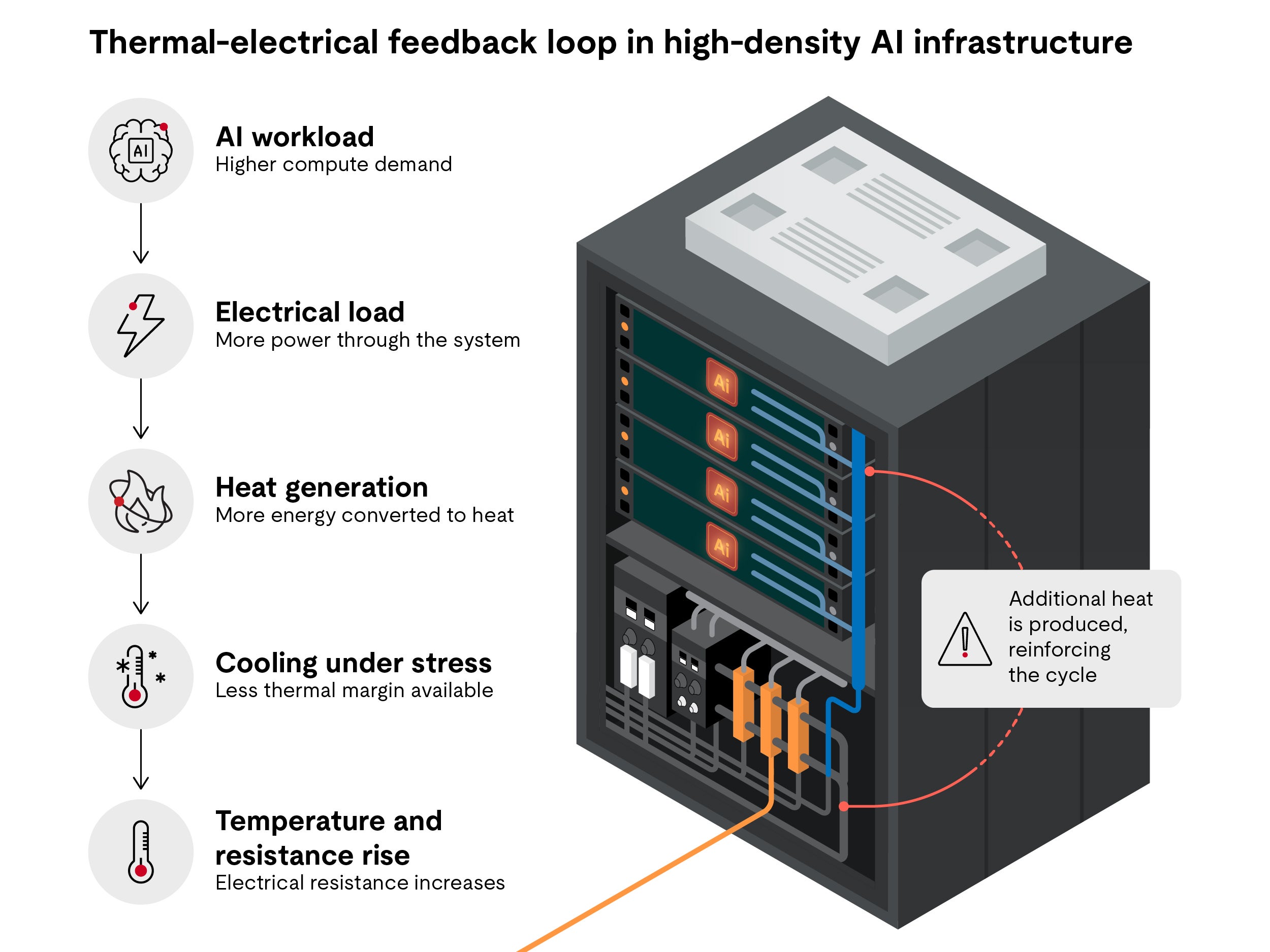
Data center fire risk in modern facilities is increasingly shaped by the interaction between electrical load, thermal behavior and material characteristics.
Higher electrical loads increase the potential for overheating under fault conditions. At the same time, new cooling technologies introduce materials and system configurations that differ significantly from traditional air-cooled environments.
Dielectric fluids used in immersion cooling systems require detailed characterization of their fire-related properties. These include flash point, autoignition temperature and heat release rate. While many dielectric fluids are designed to be nonconductive and relatively stable, their behavior under sustained high temperatures or fault conditions must be thoroughly understood.
Standards such as NFPA 75 and NFPA 76, the Standard for the Fire Protection of Telecommunications Facilities, provide guidance on fire protection in IT and telecommunications environments, while UL 9540A addresses fire propagation in energy storage systems. However, these frameworks must be applied in context, particularly where new materials and system configurations are involved.
Airflow patterns also play a critical role. In traditional data centers, airflow helps distribute heat and smoke, supporting early detection through aspirating smoke detection systems. In liquid-cooled or high-density environments, airflow patterns may be altered, affecting the transport of smoke and the responsiveness of detection systems.
Fire suppression strategies must therefore be evaluated considering changing system characteristics. Suppression effectiveness depends not only on agent selection but on enclosure design, airflow and material interactions.
Fire risk has always been influenced by the characteristics of the installation, the equipment deployed and the fire protection measures in place. In high-density and liquid-cooled environments, evolving electrical architectures, thermal conditions and new materials introduce additional considerations that may need to be evaluated alongside traditional fire protection strategies.
Modern data centers rely heavily on digital control systems to manage infrastructure performance. Systems such as data center infrastructure management (DCIM) platforms, building management systems and remote monitoring technologies enable real-time optimization of power usage, cooling performance and system availability.
As these technologies become more interconnected with physical infrastructure, they introduce cyber-physical interdependencies.
Data center cybersecurity frameworks such as UL 2900, the Standard for Software Cybersecurity for Network-Connectable Products, and IEC 62443 address requirements for connected systems. ISO/IEC 27001 provides requirements for information security management. The integration of these systems with physical infrastructure, however, introduces risks that extend beyond traditional cybersecurity concerns.
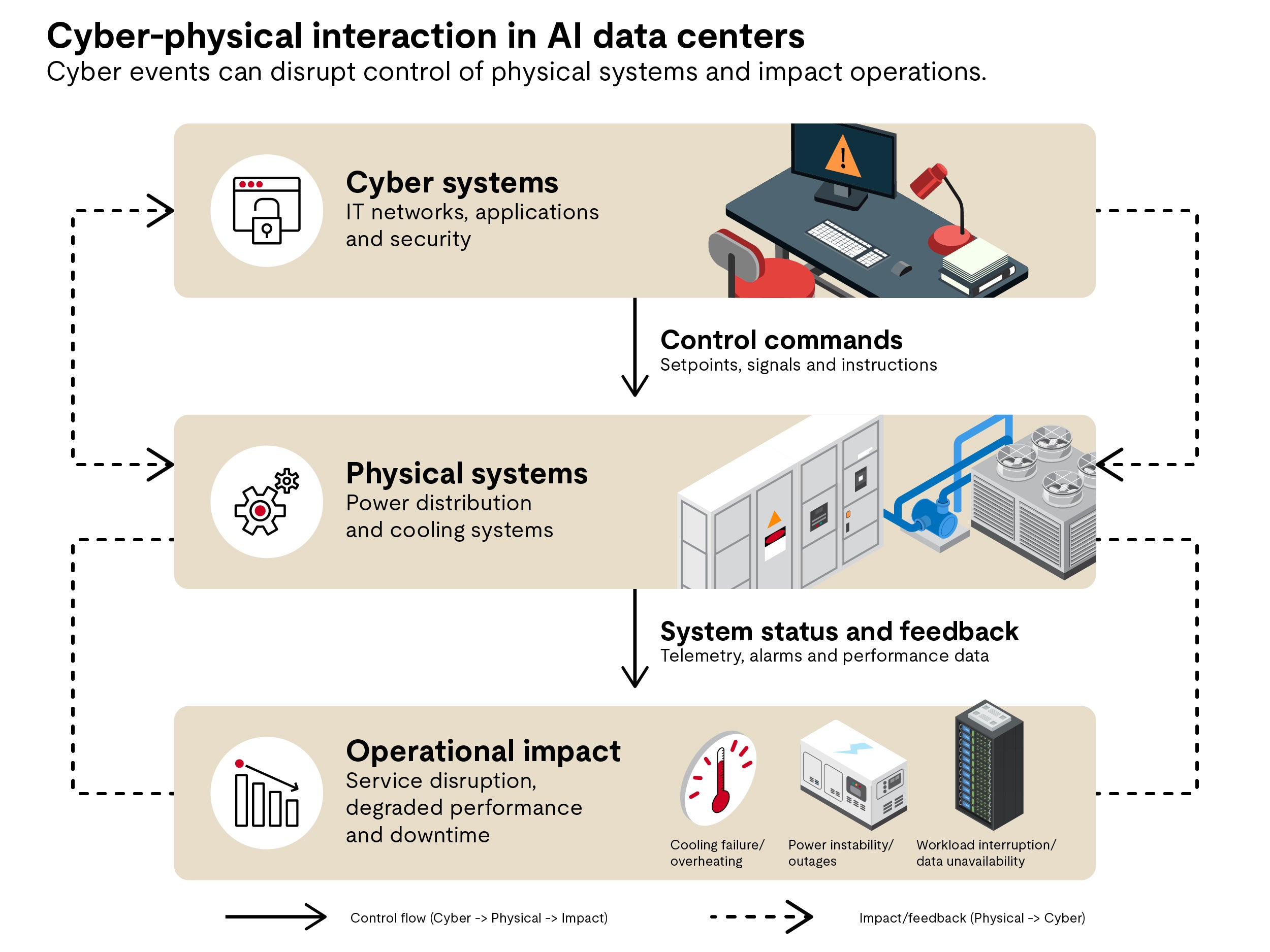
As IT systems and operational infrastructure become increasingly interconnected, cybersecurity events can have consequences beyond information security. A cyberattack targeting either enterprise IT environments or data center operating systems may disrupt services, affect infrastructure performance or impair critical control functions. Cooling systems may fail to respond correctly to temperature changes, power distribution may become unbalanced and operational continuity may be affected.
This bidirectional relationship between cyber and physical systems can create conditions in which failures are not confined to a single domain.
Data center infrastructure relies on a global network of manufacturers, suppliers and integrators spanning multiple technology domains. Equipment supporting power, cooling, computing and communications may be developed and manufactured in different regions and evaluated against different standards and regulatory frameworks, including UL Standards, IEC standards and regional requirements. Understanding these differences can help support effective system integration as increasingly complex infrastructure is deployed at scale.
While these standards share common objectives, differences in scope, testing methodologies and certification processes can introduce variability when components are integrated.
Component-level compliance may not fully address how systems perform when components are integrated and operate together.
For example, a power distribution unit certified under UL Standards may be integrated with switchgear designed under IEC frameworks. Cooling systems developed under one set of assumptions may be deployed in environments with different operating conditions. These interactions can introduce complexity that extends beyond individual component evaluation.
Supply chain coordination can help organizations manage differences in specifications, evaluation methods and deployment requirements across globally sourced components and systems. Data center safety frameworks, including UL, IEC, NFPA and EN standards, may apply differently depending on the equipment, system and deployment location. Other standards, including certain IEEE standards, may also be relevant to specific applications such as medium-voltage switchgear and grid connectivity. Understanding these differences can support effective system integration.
As AI data centers continue to scale, the question is no longer simply how to deliver more power, cooling and compute. The challenge is scaling increasingly complex infrastructure without introducing risks that threaten operational continuity.
In modern AI environments, safety, uptime and reliability are fundamentally linked. Electrical faults, cooling failures, thermal events, cybersecurity incidents and other system-level disruptions are not merely safety concerns; they can directly affect availability, performance and business continuity. As infrastructure becomes more interconnected, resilience increasingly depends on understanding how systems interact, anticipating failure modes and managing risk across the entire deployment rather than within individual technologies or components.
Traditional testing approaches often focus on individual products, evaluating compliance against defined requirements. However, data center performance and safety can also be influenced by how systems of systems operate under dynamic conditions, including changing electrical loads, thermal variation and abnormal operating scenarios.
Standards, testing and certification provide the technical foundation for emerging AI data center technologies. Equally important is planning for compliance with applicable safety requirements, codes and regulations throughout the project life cycle.
As AI infrastructure evolves, organizations are increasingly recognizing the importance of engaging AHJs and other regulatory stakeholders early in the design and deployment process. Early compliance planning can help identify potential approval challenges, support more efficient deployment and reduce the risk of costly redesigns or delays.
Collaboration across manufacturers, system integrators, operators, regulators and standards organizations helps align technical innovation with regulatory expectations, supporting safer, scalable deployment of next-generation AI data centers.
Testing, inspection and certification continue to play an important role in demonstrating compliance with applicable requirements. As new technologies are introduced, stakeholders may also need additional assessment, field evaluation and technical analysis to support deployment decisions, code compliance and alignment with evolving standards. UL, IEC and NFPA standards provide an important foundation for this work, while collaboration across the industry helps support consistent approaches to emerging technologies. This includes evaluating integrated power, thermal management and fire protection systems and assessing cybersecurity.
As AI data center technologies continue to evolve, decisions made during planning, siting, construction and commissioning can have a significant influence on long-term safety, reliability and operational performance. Identifying technical, operational and compliance considerations early in the project life cycle can help organizations reduce risk and support more effective deployment outcomes. These considerations may include power availability, infrastructure readiness, regulatory requirements and the integration of complex systems that must operate together safely and reliably.
UL Solutions helps data center owners, operators, manufacturers and investors reduce risk, accelerate innovation and scale safely. Our testing, evaluation and certification services span power supply, computing infrastructure, cooling management, built environment and operational efficiency — covering the full data center ecosystem, from grid to chip.
To speak with an expert about your data center safety, performance or compliance needs, visit UL.com/DataCenters
Ken Boyce, Vice President, Principal Engineering | Industrial, UL Solutions
Ken Boyce is a Corporate Fellow in the William Henry Merrill Society at UL Solutions — a distinction reserved for the highest level of technical achievement, external recognition and contributions to its safety mission. He influences global trends in energy, safety, risk management, sustainability and technology through his engagements as a researcher, technical expert, speaker, lecturer and author at symposia, government events and universities. For more on Ken, visit UL.com/about/people/ken-boyce

Emerging Risks in AI Data Centers
Thanks for your interest in our products and services. Let's collect some information so we can connect you with the right person.