
Understanding how immersion cooling affects long-term battery degradation
Battery degradation is a complex phenomenon. The usage of special strategies like immersion cooling can optimize battery degradation and increase safety. However, immersion cooling introduces greater system complexity, which can increase costs and introduce additional failure modes. This use case explores long-term battery degradation, potential safety risks and cell-to-cell variability over the pack lifetime.
Use case summary
Challenge
Optimizing battery degradation and inhomogeneity in a battery pack while increasing safety despite greater complexity.

Approach
Comparing immersion and conventional cooling under real-world conditions and investigating cell-to-cell variation before assembly and at end of life.

Results
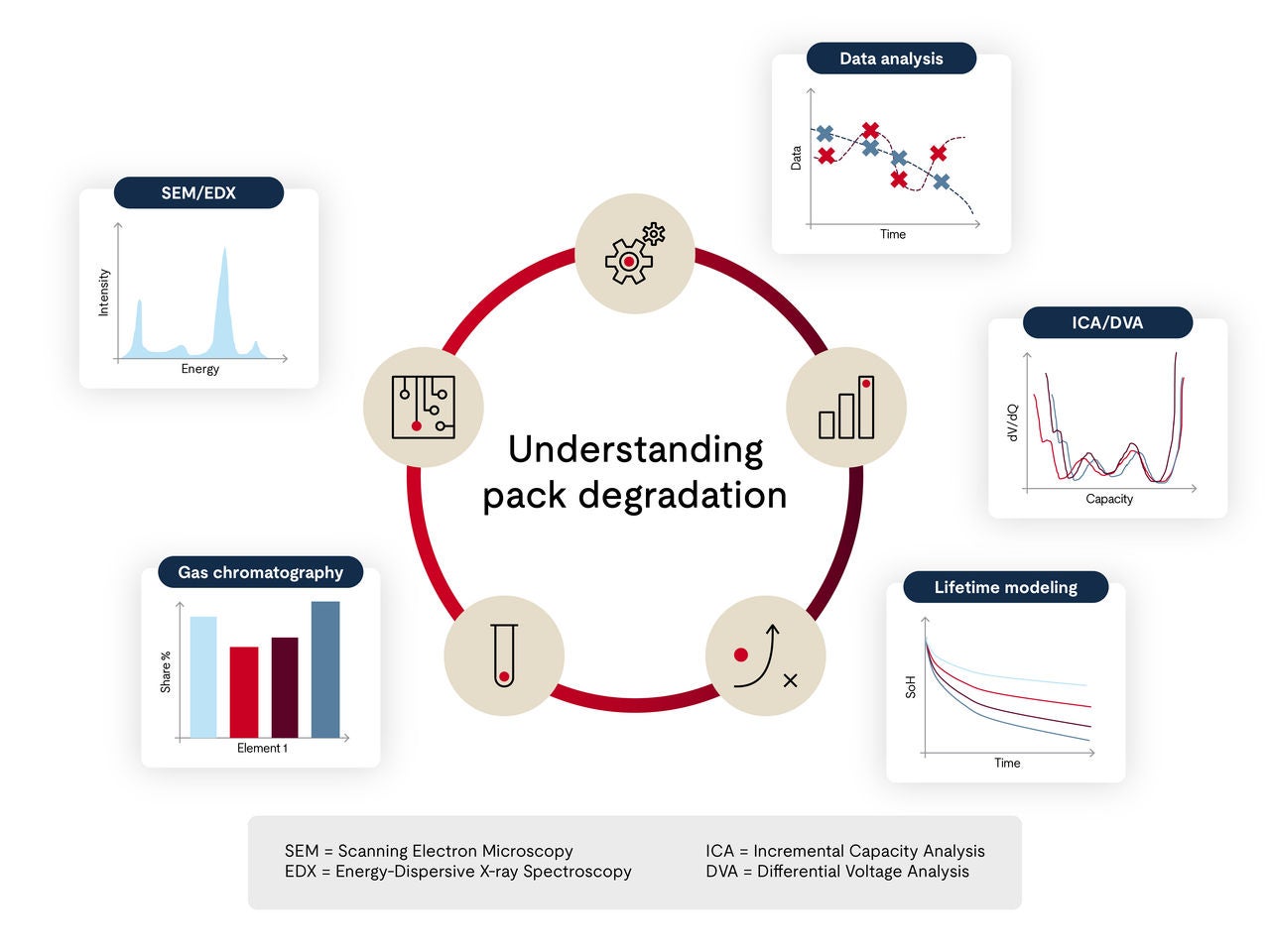
Although cells age more uniformly under an immersion cooling system, outliers appear during the pack lifetime. Noninvasive and invasive techniques can help identify the reason for this behavior.
Understanding the benefits of immersion cooling strategies
Battery degradation is a complex task that requires multi-disciplinary knowledge.
When it comes to battery pack and uniform temperature distribution and homogenous degradation, understanding different interconnected factors require extensive expertise including battery-working principles and electrochemistry, usage of invasive and noninvasive techniques, modeling and simulation, and testing.
Read the full use case
UL Solutions helps customers understand complex phenomena, whether they occur during product development or in the last stage of design and product validation. With a focus on safety science, our teams of battery experts deliver comprehensive solutions from the material level up to the system level.
.jpg?width=150)
Battery Simulation Use Case 01
900 KB
X
Get connected with our sales team
Thanks for your interest in our products and services. Let's collect some information so we can connect you with the right person.
Please wait…
Characters remaining