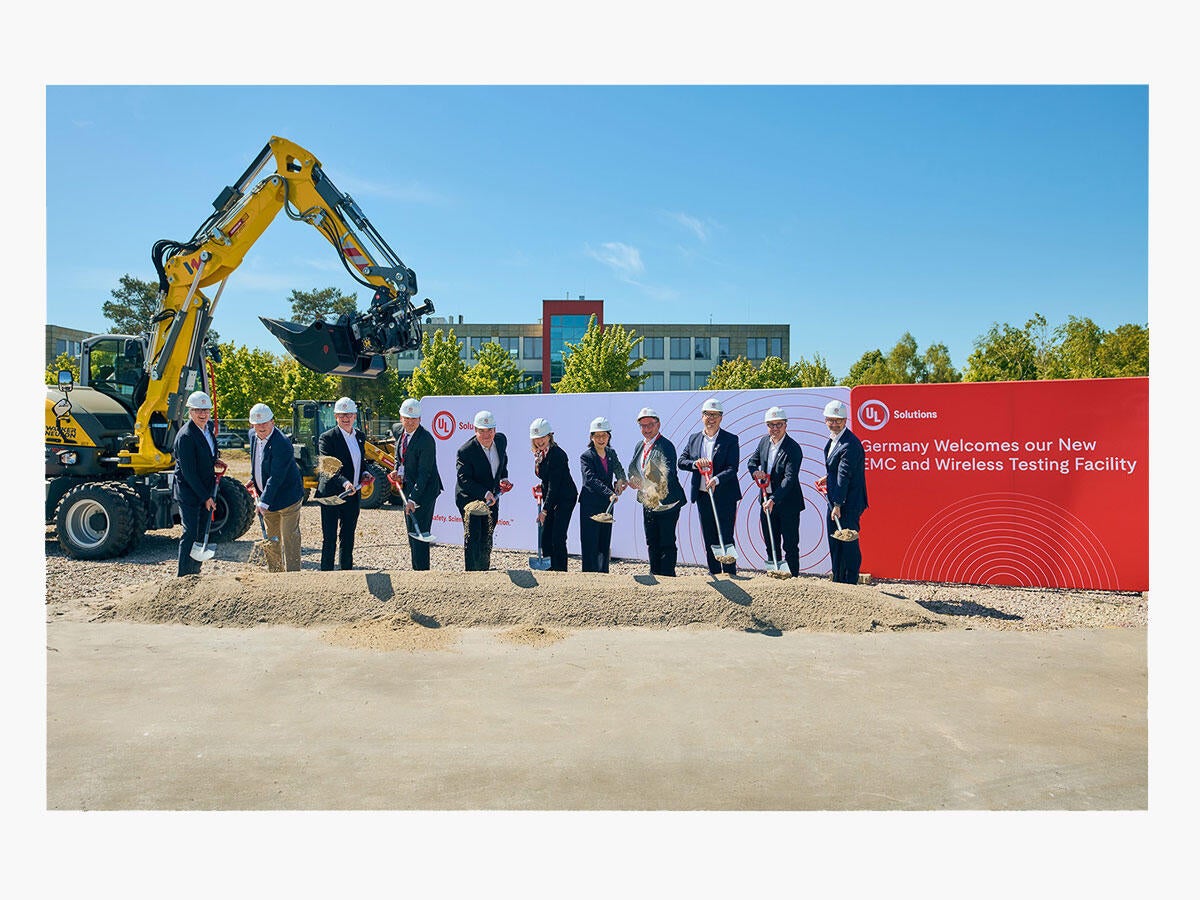
May 11, 2026
Key Points
- UL Solutions plans to expand EMC and wireless testing capacity in Europe with construction of a new, state-of-the-art laboratory in Germany, supporting safety certification and regulatory compliance for large, high-power and increasingly connected products.
- The Neu-Isenburg facility is projected to be operational in mid-2027, and it will offer advanced wireless testing services across Wi-Fi, Bluetooth, cellular, GPS and RFID, addressing compliance needs for numerous sectors, including industrial, medical and automotive.
- By increasing regional access to large-scale EMC testing, wireless testing and safety certification services, the new laboratory will help manufacturers efficiently bring safer products to market.
As connected technologies grow in scale and complexity, demand for advanced electromagnetic compatibility (EMC) and wireless testing continues to rise across Europe. UL Solutions is responding with a major investment: construction of a new EMC and wireless testing laboratory in Neu-Isenburg, Germany, designed to support larger, more complex and highly connected products. The laboratory will be situated on UL Solutions’ existing Neu-Isenburg campus, near Frankfurt.
This Q&A explores what the new facility will deliver, why it matters now and how it will advance safety science. Additional details are available in the company’s April 29 press release.
What is UL Solutions announcing?
UL Solutions announced that it has broken ground for a new EMC and wireless testing laboratory in Neu-Isenburg, Germany. The facility will expand regional capacity to test large, high-power and connected products, strengthening UL Solutions’ support for European and global manufacturers.
Why is this investment important?
Products and systems are becoming increasingly connected, software-enabled and data-driven, intensifying the complexity of regulatory requirements. Companies need advanced testing expertise close to where products are designed and built in order to reduce risk, meet safety standards and accelerate time to market.
Who will benefit from the new laboratory?
The facility will support manufacturers across the industrial automation, medical technology, energy systems, telecommunications and automotive sectors, particularly those developing large, complex or mission-critical systems that require specialized EMC and wireless testing.
What capabilities will the facility offer?
The laboratory will provide large-scale EMC testing and advanced wireless testing across Wi-Fi, Bluetooth, cellular, GPS and radio frequency identification (RFID). The facility will include a 10-meter chamber suitable for testing heavy, high-power equipment, addressing a gap in large-scale testing capacity in Europe. This chamber is designed to test equipment up to 4 meters in length and weighing up to 5 tons, with power capabilities of up to 200 amps per phase.
When will the new laboratory be operational?
The facility is projected to be operational in mid-2027.
What does this new laboratory mean for UL Solutions customers?
Companies will be able to test larger, more complex connected products closer to their R&D and manufacturing locations. This local access will help streamline compliance efforts, reduce development risk and support faster, more confident product launches across global markets.
How does this investment support innovation in emerging technologies?
The new facility is designed to support innovation across energy systems, digital infrastructure, AI-enabled technologies and other applications. With a footprint designed for future expansion, this facility will enable UL Solutions to help manufacturers navigate evolving regulations while delivering more reliable, connected products at scale.
What does this milestone say about the future of safety science in Europe and beyond?
This investment reinforces UL Solutions’ long-term commitment to Germany, Europe and global safety science leadership. Expanding regional expertise and infrastructure strengthens Europe’s testing ecosystem while supporting trusted innovation and global market access.
How does this support UL Solutions’ broader strategy?
The new laboratory will strengthen UL Solutions’ European footprint, and it will reinforce the Neu-Isenburg site as a UL Solutions Center of Excellence, bringing together advanced testing, certification and technical expertise in one location. Additionally, it will expand the company’s global network of EMC and wireless testing facilities in Europe, Asia, Mexico, the United Kingdom and the United States.
How does the facility address sustainability issues?
The building is designed for low environmental impact, incorporating rooftop solar, advanced building controls and water management systems, and meeting current German energy-efficiency standards to reduce its environmental footprint.
Information about how UL Solutions helps companies achieve regulatory compliance is available on the EMC Testing and Certification page at UL.com.