August 28, 2026
Authored by Ihsan Budi Saputro
Saudi Arabia has implemented significant changes to technical regulations covering communications and information technology (ICT) equipment.
These changes (link in Arabic), which became fully effective on Feb. 16, 2025, impact wireless devices, including mobile phones, routers, Internet of Things (IoT) devices and any equipment using radio frequencies. Companies active in Saudi Arabia should be aware of how it impacts compliance, certification and market access for telecom and ICT products.
Key changes to ICT regulations
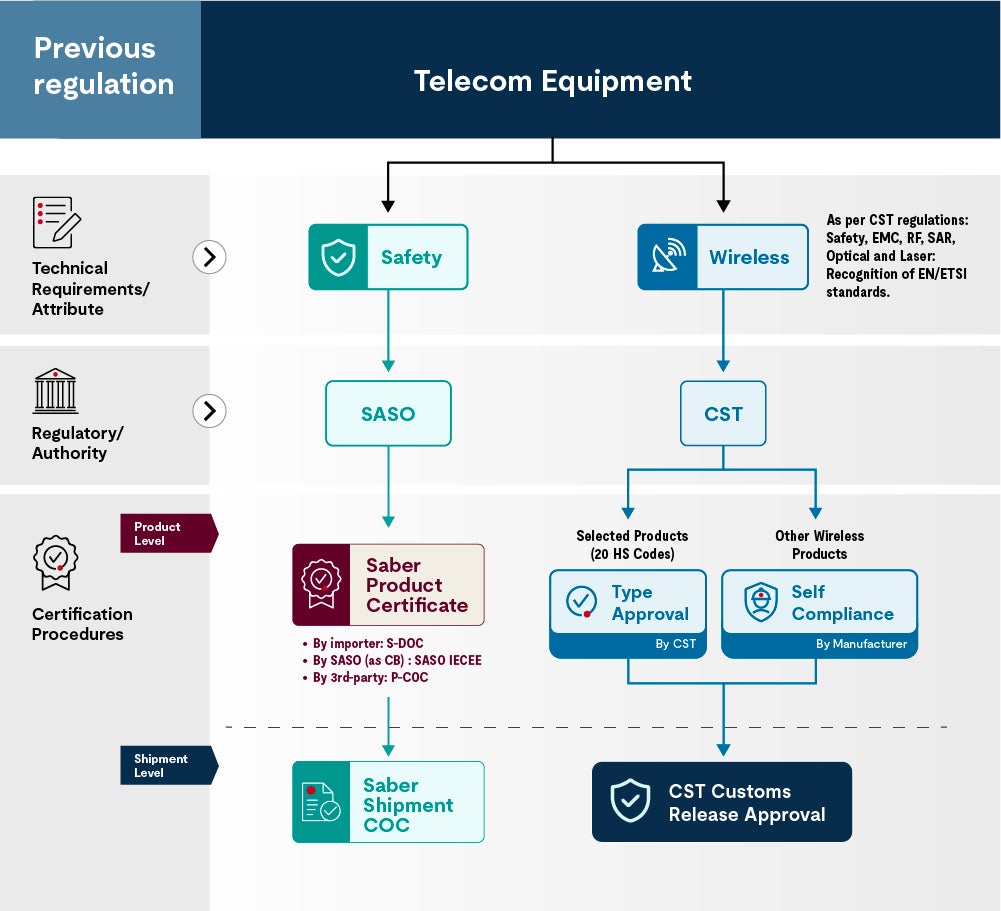
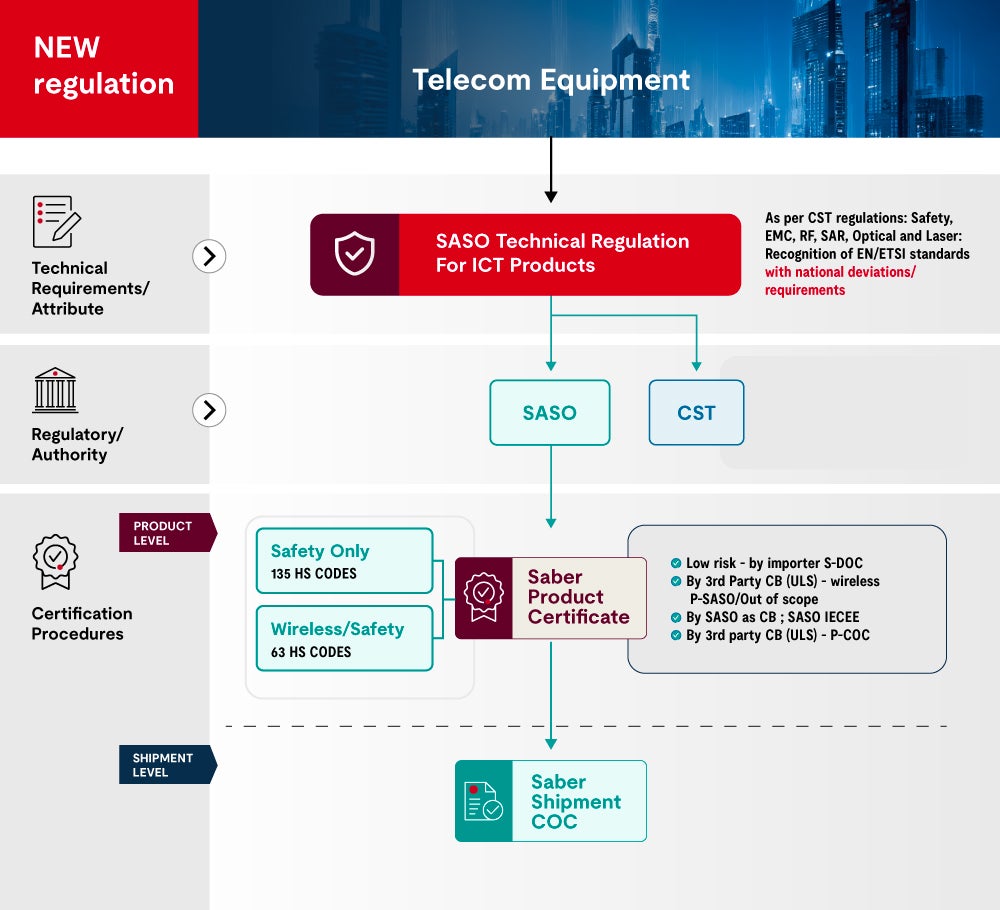
Shift in oversight — Communication, Space, and Technology Commission (CST) will no longer issue wireless type approval certificates as such approval will be under the authority of Saudi Standards, Metrology and Quality Organization (SASO). SASO-approved Certification Bodies will issue Saber Product Certificate covering both electrical safety and wireless.
Broader coverage More products will be covered by mandatory wireless certification as HS Codes of products that were in-scope of CST Type Approval increased from 20 HS Codes to 63 HS Codes and products subject to Safety/EMC requirements are now 135 HS Codes.
The following graphic showing process differences between the previous and new regulations.
Previous regulation:
New regulation
Four updates to scoping
Since SASO will issue certificates covering both safety and wireless, there will be four types of conformity assessment processes. Applicability is determined by the product’s HS Code.
Product Certificate of Conformity (PCOC) — Applicable to products subject to safety/EMC requirements only.
Product Certificate of Conformity — Communication, Space, and Technology Commission (PCOC-CST) applicable to products subject to safety and wireless requirements.
IECEE recognition certificate — Applicable to products listed in Appendix 3 of the new regulation subject to Safety/EMC requirements only.
IECEE recognition certificate + CST Saber certificate —
Applicable to products listed in Appendix 3 of the new regulation subject to safety and wireless requirements.
HS Codes subject to safety/EMC requirements or Safety/Wireless requirements are subject to change. Please refer to the Saber portal for the most up-to-date list.
Changes to technical specifications
CST will remain the issuer of technical specifications for certification purposes for wireless products.
Products must comply with the following requirements:
- SASO-CITC-GEN001 for all equipment
- Either SASO 3114 or SASO-CITC-GEN003 depending on the product type:
- SASO 3114 is applicable to mobile phones, tablets, mobile computers, mobile routers, customer premises equipment (CPE), Optical Network Terminal (ONT), Home Access Gateway (HAG), Wi-Fi Distribution Services, and other cellular-enabled devices.
- GEN003 is applicable to devices working with a radio transmitter module including if combined with non-radio equipment
- Technical specification for a specific technology listed in Appendix 1, for example SASO-CITC-RI054 for short range devices (SRD)
Additional requirements
The updated regulation introduces additional requirements as follows :
- USB Type C requirement — Electronic devices listed in Appendix 2 including smartphones, tablets, and laptops at minimum must have USB Type C as the connection and charging port. Manufacturers must submit a test report as a proof of compliance with this requirement.
- Full Power Delivery compatibility — If the device can be charged using a wired cable with a voltage higher than 5V, a current higher than 3A, or a power higher than 15W, the device must be Full Power Delivery (USB PD) compatible.
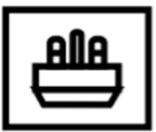
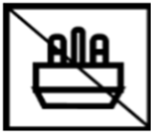
Marking requirements — For mobile phones and tablets, the Saudi plug symbol (MK) must be affixed on the packaging if the product is sold with a charger included. If a charger is not included, the Saudi plug symbol (MK) with strikethrough is optional.
Compliance and transition deadlines
Manufacturers were given a six-month transition period until Feb. 16, 2025 to fully comply with this new regulation.
However, products that entered the market prior to the publishing date were given a one-year transition period to demonstrate compliance with the technical requirements stipulated in the new technical regulation.
Contact us for more information on how UL Solutions can support market access of your products to Saudi Arabia. With deep expertise and a long-standing presence in the Saudi market, UL Solutions helps you navigate evolving compliance requirements.
Notes:
HS Codes subject to Safety/EMC requirements or Safety/Wireless requirements are subject to change. Please refer to Saber portal for the up-to-date list.
Get connected with our sales team
Thanks for your interest in our products and services. Let's collect some information so we can connect you with the right person.